
A good cold email follow-up in 2026 brings something the first email did not: proof, a useful resource, or an observation about the lead’s company that ties to the problem you solve. “Just checking in” gives the reader nothing to answer.
This article gives you a two-week sequence of three follow-up emails with LinkedIn steps between them, a template for each step, templates for situations such as a new signal, a “not right now” or a call, and what to do once the sequence ends.
The follow-up sequence: three emails and LinkedIn steps
The sequence assumes your first email went out on day 0 and got no reply. If that email needs work, start with how to write cold emails that get responses . Each follow-up has its own angle. The first goes in the same thread. The second and third start new threads with new subject lines, because the angle has changed.
| Day | Channel | Step | What it brings |
|---|---|---|---|
| 0 | First email | The signal and the offer | |
| 1 | Profile view, then connection request | Familiarity, no pitch | |
| 3 | Follow-up 1 | Proof from a similar company | |
| 5 | Comment on a recent post | A real point about what they wrote | |
| 7 | Follow-up 2 | A useful resource | |
| 9 | Short message, if they accepted | A light nudge | |
| 12 | Follow-up 3 | A specific observation about their company | |
| 14 | None | Stop | Pause, then nurture |
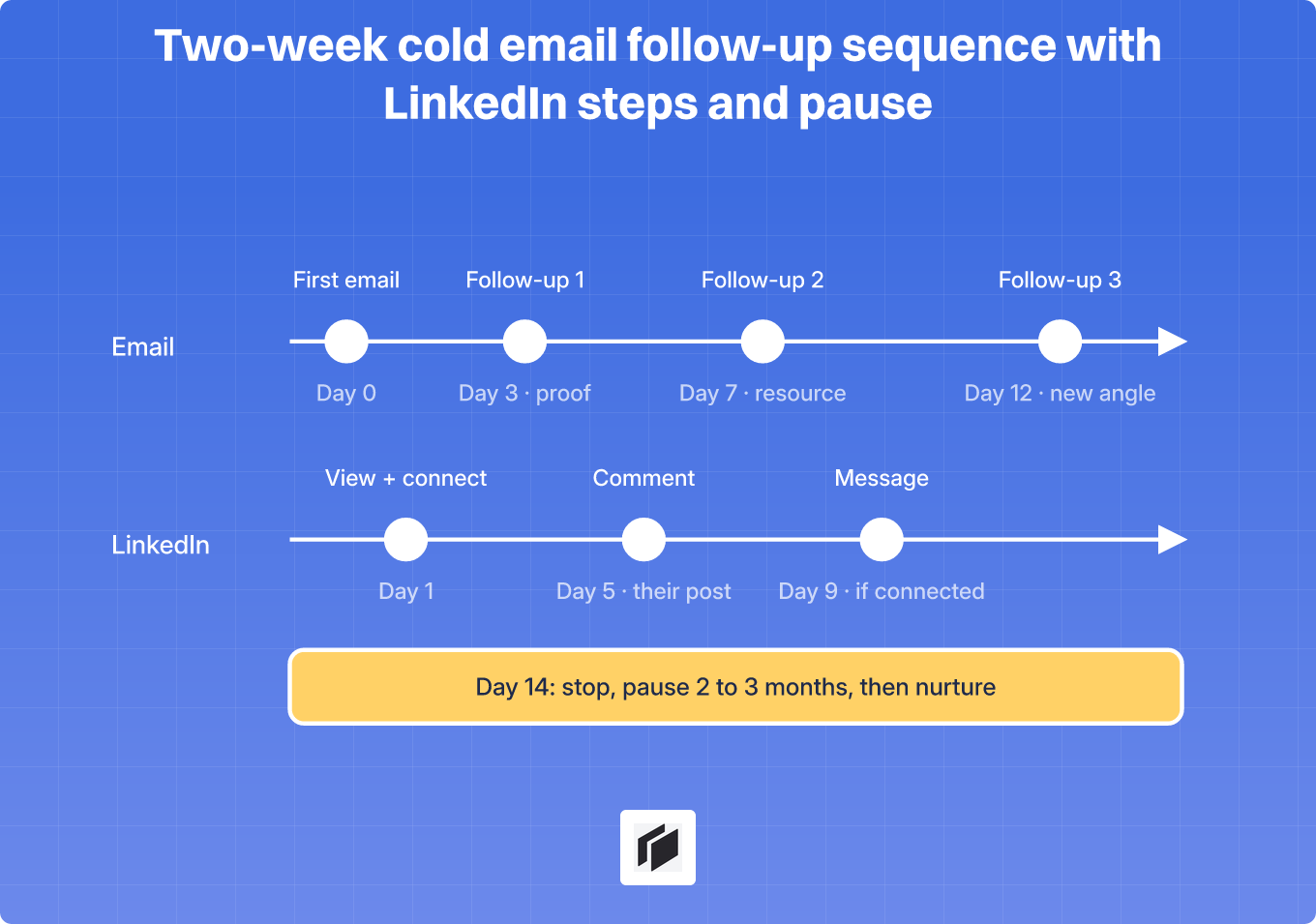
The days are a working default, not a measured optimum. Instantly’s 2026 benchmarks suggest 2 to 3 days before the first follow-up and 4 to 7 days between later ones, and this sequence stays inside that range. As a rule of thumb, send the emails as plain text and keep each one under about 80 words.
Three follow-up email templates, one angle each
Open tracking is the one setting to change before you send any of them.
Follow-up 1: proof from a similar company (day 3)
The first follow-up answers the obvious question of whether this works for a company like theirs. Reply in the same thread, name a customer that resembles the lead, and give one result. Only use a result you can stand behind.
Hi [First name],
A different angle from my first note. [Similar company] had the same problem as [Company], [problem tied to the signal], and after [one change they made] they [result in one line].
Given [specific fact about their company], I think you are in a similar spot. I can send the one-page breakdown of how they did it. Want it?
[Your name]
Follow-up 2: a resource they can use (day 7)
The second follow-up gives something away. A benchmark, a teardown, a checklist or a short video that fits their situation asks “was that useful” instead of “will you take a call”. Do not gate it behind a form, and keep to one link.
Hi [First name],
I put together [one-line description of the resource] for [their role or segment]. The part on [section] is closest to what [Company] is dealing with: [link].
No reply needed. If something in it is off for your case, I would like to know.
[Your name]
Follow-up 3: a specific observation about their company (day 12)
The third follow-up is the one that takes research. You look at something concrete, such as their pricing page, their open roles, their onboarding or a recent post, and say what you noticed and what it usually means for the problem you solve.
What separates this from fake personalization is the link to the problem. “Loved your recent post” is flattery, the 2026 version of “hope this finds you well”. An observation gives the lead something to agree or disagree with. For more on telling the two apart, see how to personalize cold emails at scale .
Hi [First name],
I looked at [specific thing: pricing page, open roles, onboarding flow]. [What you noticed, as a fact]. In teams like yours that usually means [consequence for the problem you solve].
One thing I would test: [concrete suggestion, one sentence]. Does that match what you see on your side?
[Your name]
Filled in, with a made-up company:
Hi Sam,
I looked at Northwind’s careers page. You have three SDR roles open and none of them mentions sourcing leads. Teams that hire this way often have new reps building lists by hand.
One thing I would test: give new reps a pre-enriched list for their first two weeks. Does that match what you see on your side?
Mia
LinkedIn steps inside the sequence
The LinkedIn steps give people who ignore their inbox another way to answer, and in our experience a name they have already seen is easier to place when the later emails arrive. Belkins’ 2026 study advises switching to LinkedIn when a three-step email sequence gets no engagement. We run the two channels side by side instead, because these steps cost the lead very little.
- Profile view (day 1). Open their profile, which they may notice.
- Connection request (day 1). Send it with a short note or none, and leave the pitch out. Our LinkedIn connection note examples show what fits in the limit.
- Comment (day 5). Reply to a recent post with a point of your own, in a sentence or two.
- Short message (day 9). Only if they accepted. Make it useful on its own and keep it to two or three sentences.
Hi [First name], I follow what you post about [topic] and work in the same space. Would be good to connect, no pitch.
Thanks for connecting, [First name]. I emailed you about [problem], so here is the short version: [one useful thing, such as a benchmark or a result from a similar company]. Happy to send more if it is relevant.
Templates for real situations
These cover moments the standard sequence cannot predict.
A new signal appears mid-sequence
When a lead hires for the role you help with, raises money or changes tools while your sequence is running, stop the remaining steps and send an email built on the new fact. The reason you are writing has changed, so the email has to change too.
Hi [First name],
I wrote to you earlier about [problem]. Today I saw that [Company] [new signal, for example “just opened three SDR roles”], which is the moment [problem] usually gets expensive.
[One concrete suggestion tied to the signal]. Worth a short look this week?
[Your name]
The right person is someone else
If the lead does not own the problem, a referral request is easy to answer because it takes one line. Start a new thread with a new subject, and make it forwardable by describing the problem in one sentence.
Hi [First name],
I am trying to reach whoever looks after [function] at [Company], because [one-sentence reason tied to a signal]. If that is you, a one-word reply is enough and I will send details. If not, a name helps a lot, and feel free to forward this.
Thanks,
[Your name]
After a “not right now”
Treat a “not right now” as a lead for later. Thank them, ask which event would put the problem back on their list, and promise to write when you see it.
Hi [First name],
Understood, and thanks for telling me. Which would be the earlier sign that [problem] is back on your list: [signal A] or [signal B]? I will get back in touch when I see it, and stay quiet until then.
If you would rather I did not, tell me and I will stop.
[Your name]
After a call or meeting
Send the recap within a day. Repeat the problem in the lead’s own words, state the next step and make it small.
Hi [First name],
Thanks for the time today. What I took from it: [their main problem, in their words], and [one constraint they mentioned, such as budget or timing].
The next step I suggested was [specific action, such as a trial on 50 of your leads]. I attached [resource they asked for]. Does [day] work to look at the results together?
[Your name]
After the sequence: stop, nurture, re-engage on a new signal
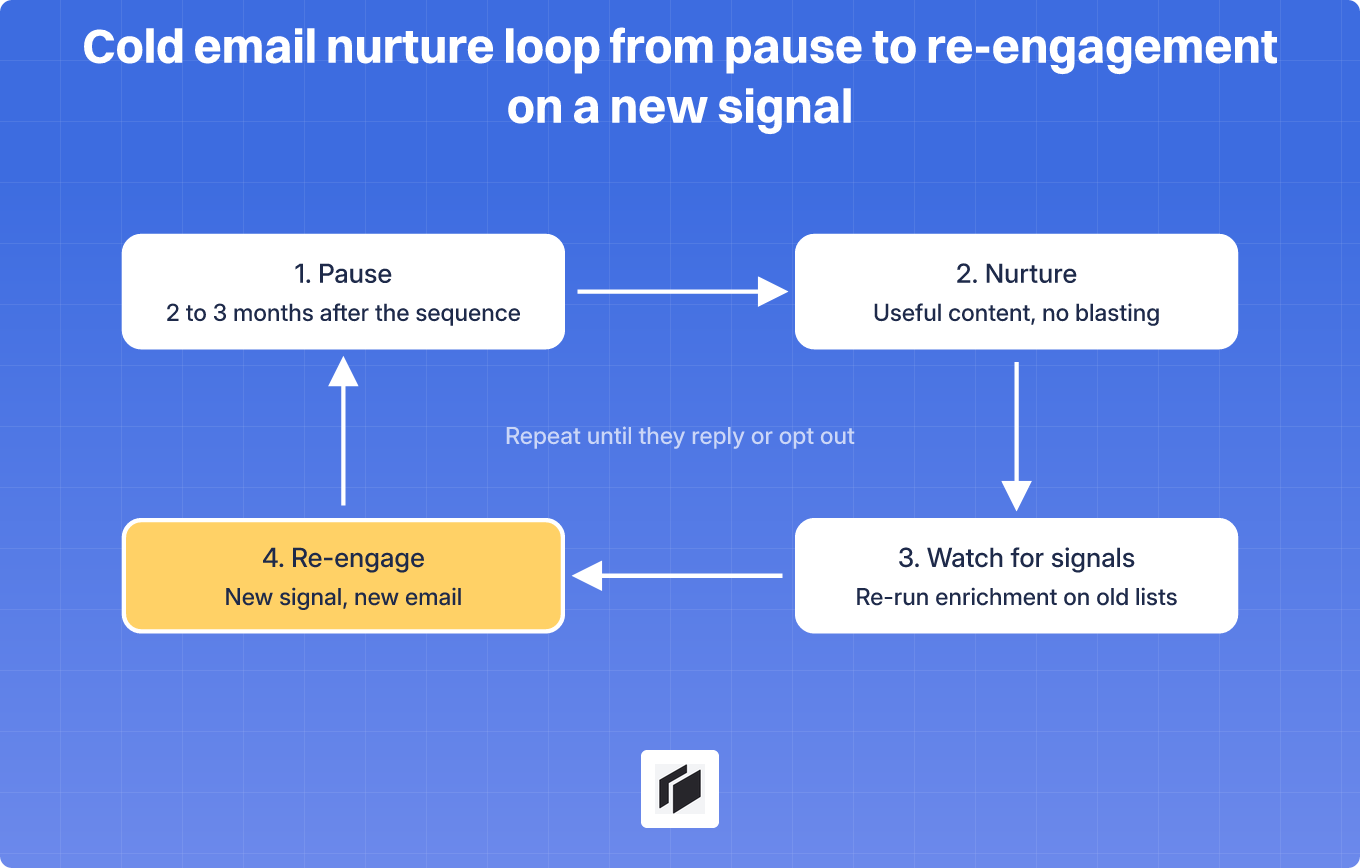
On day 14, stop. Instantly’s benchmarks say to stop after the sequence and wait 2 to 3 months before re-engaging, and that is our default too. We skip the “breakup” email: in our view it adds one more message to an inbox that has already ignored four, for a reply you are unlikely to get.
The lead stays on your list after the last email. Many good-fit accounts are simply not ready this month, so the ones who did not reply and the ones who said “not right now” go into a nurture list and come back when something changes. A strong signal can justify writing sooner than 2 to 3 months, as in the mid-sequence template above.
The re-engagement email on a new signal
The re-engagement email carries the one thing the earlier emails lacked, which is a reason to write now. Refer to the earlier contact in a sentence, name the new fact and ask only for interest.
Hi [First name],
I wrote to you in [month] about [problem], and it was not the right time. I noticed [new signal: new role, funding, a tool change, a post of theirs], which usually puts [problem] back on the table.
[What has changed on your side since, or a fresh observation]. Is this worth a look now, or still not a priority? I will leave it either way.
[Your name]
What nurturing looks like in practice
Nurturing means staying visible in ways the lead can ignore at no cost, which rules out a second sequence.
- LinkedIn presence. If they accepted your connection, they see your posts. Posting about the problem your segment has is enough.
- Useful content, with permission. A short note with a benchmark or a teardown, only for people who asked for it.
- Signal watching. Job changes, funding rounds, new roles, tool changes, a visit to your site or a reaction to your content. Re-run your enrichment on the old list every month or two to catch them.
Keep an opt-out in anything you send repeatedly, and drop anyone who asks to stop. Whatever you send should be worth reading without a meeting attached.
How many follow-ups to send and when
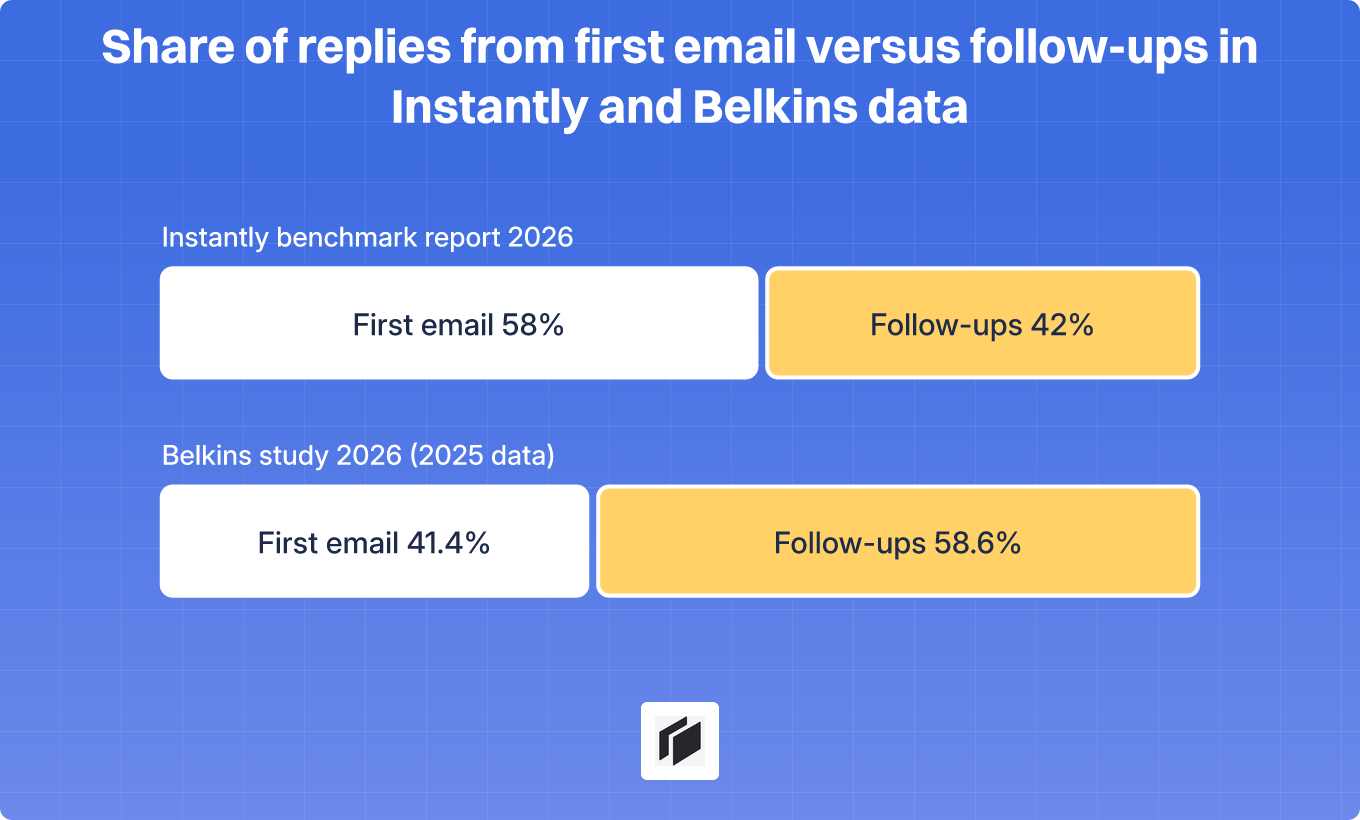
The three main datasets agree that follow-ups matter and disagree on the size. Instantly’s benchmarks say 58% of replies arrive on step 1. Belkins’ 2026 study of 7,530,489 emails sent in 2025 found the first email delivered 41.4% of replies and steps two to six delivered 58.6%. Hunter’s report on 31 million emails reports total replies of 6.8% for sequences of three messages against 3.3% for one.
All three are vendors with their own senders and ways of counting, so treat the figures as a range. What they share is that stopping after one email leaves a large share of replies unclaimed.
The sources also disagree on length:
| Source | Recommended length |
|---|---|
| Instantly (2026) | Three emails per prospect as best practice, yet “most high-performing sequences” use 4 to 7 emails over 14 to 21 days |
| Belkins (2026) | 3 to 5 steps, with step 3 booking more meetings than steps 1 and 2 |
| Hunter (2025 data) | Three messages in total, with reply rates peaking at four in its earlier analysis |
A first email plus three follow-ups is four emails. That is one above Hunter’s and Instantly’s three, and inside Belkins’ and Instantly’s other ranges, so it is a judgment call. Belkins found that step 3 books more meetings than steps 1 and 2 together, so the third email should never be a nudge. In this sequence that is follow-up 2, the resource.
Write each follow-up from research
The templates have bracketed gaps, and the quality of each email depends on what goes in them. For ten leads you can fill them by hand. For a few hundred, the gaps become the bottleneck and tend to get filled with generic lines.
A spreadsheet fixes this by keeping the research next to the email. In Cockpit each lead is a row. You import them from a LinkedIn search, from people who reacted to or commented on a LinkedIn post, from Google Maps, a CSV or your CRM. Enrichment columns add emails, company and tech data, and AI research columns read the lead’s website, roles and posts. An AI column then writes the follow-up from those fields: the proof that matches the lead’s segment, the resource that fits their role, and the observation for follow-up 3. You choose the segment and the offer and read a sample of rows before anything goes out.
The same sheet supports the nurture phase. The rows stay where they are, so you can run the enrichment again later and filter for the ones where something changed.
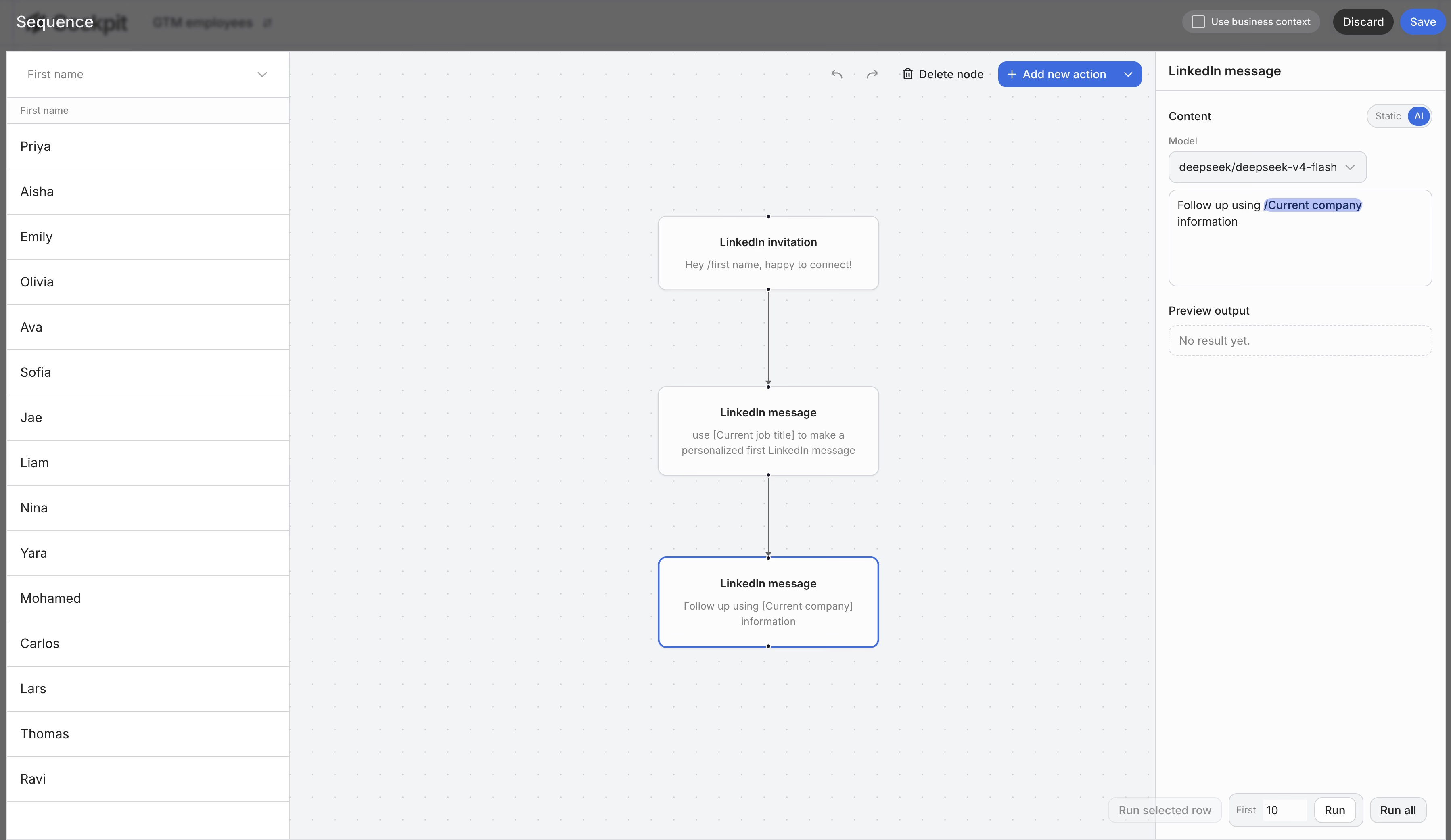
Cockpit prepares the lists and copy and exports them to Lemlist or Instantly (or as a CSV for another sequencer), which send the emails. Exporting sequence steps needs the Growth plan or higher. Plans start at $29 a month with 3,000 credits and a 14-day trial, and you pay only for successful lookups. Prices are from the pricing page as checked in November 2026.
FAQ
How many follow-up emails should you send after a cold email?
Three after the first email is our default. Belkins suggests 3 to 5 steps in total, Hunter and Instantly say three emails, and Instantly’s high-performing sequences run 4 to 7, so four emails is a middle path.
How long should you wait before following up?
Instantly’s benchmarks suggest 2 to 3 days before the first follow-up and 4 to 7 days between later ones. Day 3, then day 7, then day 12 follows that.
What should a cold email follow-up say?
It should add something new: proof from a similar company, a useful resource or a specific observation about the lead’s company tied to the problem. Avoid “just checking in”, which adds nothing.
Should you follow up on LinkedIn too?
Yes. Belkins advises switching to LinkedIn when a three-step email sequence gets no engagement, and we run it alongside the emails. A profile view, a connection, a comment and a short message fit between them.
Do you need a breakup email?
We skip it. After the last follow-up, stop, as Instantly advises, and write again when a new signal gives you a reason, using the re-engagement template above.