
A tool that finds a mobile number for nine out of ten North American contacts can find one for four in ten in Germany.
Phone number enrichment adds a mobile or direct number to a lead you already have, usually from a name and a company or a LinkedIn URL. The right tool depends less on its size than on where your leads are, because every vendor sources numbers differently from one country to the next.
In North America, one good database is enough. In most of Europe, APAC and LATAM, a waterfall that tries several providers finds far more. Here is the pick for each region, the coverage data behind it, what a found number costs, and the rules to follow before you dial.
The best phone enrichment tool by region
These picks rest on Clay’s mobile phone tests, last updated in October 2025, and on what vendors publish. The full figures are in the coverage tables of the next section. For a wider view of vendors beyond phones, see the B2B data enrichment tools comparison .
USA and North America
A single database is enough here. ContactOut and Wiza each found a mobile for more than nine in ten North American contacts in Clay’s test, a few points behind BetterContact’s waterfall. Pick on price: ContactOut up to its 1,000 numbers a month, Wiza beyond that. Lusha or Apollo work too if your team already prospects in them. Screen numbers against the Do Not Call registry before dialing.
UK
BetterContact, with 86% coverage in Clay’s test. FullEnrich is the second choice at 75%. ContactOut reports 85% UK coverage for itself, but reached 64% in Clay’s test. Screen every number against the TPS and CTPS registers, or use Cognism, which screens them for you.
DACH and Germany
BetterContact first, FullEnrich second. Germany and Austria are where single databases fall furthest behind in Western Europe: Wiza and ContactOut found a mobile for about half of German contacts or fewer. Switzerland is easier, with every tool in the test above 55%. Cognism markets its European data, Germany included, but publishes no phone coverage by country.
France
FullEnrich or BetterContact. France is FullEnrich’s best European result in Clay’s test, at 81%, and BetterContact reached 88%. Single databases trail by 20 points or more.
The Nordics
BetterContact or Datagma. Coverage is high across Sweden, Norway, Denmark and Finland, and Datagma comes closer to the waterfalls there than anywhere else in Europe. The Nordics also had the best right-person rate in one agency’s call logs, covered in the verification section.
Eastern Europe
BetterContact. Only Poland has been tested, where it reached 85%. No vendor publishes phone figures for other Eastern European countries, so check the first results by hand before you run a large list.
APAC
BetterContact first, then ContactOut for Australia, India and Singapore, where ContactOut publishes 72% to 79% coverage. Quality drops in this region. BetterContact’s APAC numbers passed Clay’s quality checks 74% of the time, against 89% in North America and Europe. Keep an email step for the contacts left without a number.
LATAM
ContactOut first, with 74% coverage in Clay’s test, then BetterContact on the misses. FullEnrich reports 67% for LATAM phones.
Phone coverage by region: what the tests show
The most complete public comparison is Clay’s, run with The Kiln. Its European test covered about 5,000 contacts in 15 countries. Every number returned was checked by two verification services, Trestle and Scoreplex, for line type and name match. The numbers were not dialed. Clay sells these providers in its marketplace, so it is not neutral, but it is not one of them either.
The table shows coverage, the share of contacts each tool returned a mobile for. Regions come from the region test (opens in a new tab) and countries from the European country test (opens in a new tab) . A dash means the tool was not tested there.
| Region or country | BetterContact | FullEnrich | Datagma | ContactOut | Wiza |
|---|---|---|---|---|---|
| North America | 97% | – | 93% | 96% | 91% |
| UK | 86% | 75% | 72% | 64% | 58% |
| Germany | 81% | 74% | 67% | 51% | 41% |
| Austria and Switzerland | 85% to 89% | 58% to 76% | 74% to 75% | 55% to 69% | 40% to 56% |
| France | 88% | 81% | 71% | 63% | 52% |
| Nordics (SE, NO, DK, FI) | 87% to 94% | 64% to 75% | 68% to 83% | 69% to 76% | 62% to 67% |
| Poland | 85% | 65% | 64% | 69% | 50% |
| APAC | 68% | – | 56% | 55% | 37% |
| LATAM | 69% | – | 49% | 74% | 30% |
Two other tools from this article appear in the test. Enrow reached 43% in the Middle East and Africa and 23% in LATAM. LeadMagic reached 31% in North America and 5% in APAC. Outside this list, Surfe led LATAM at 78%, and Zeliq came within about ten points of BetterContact in every region.
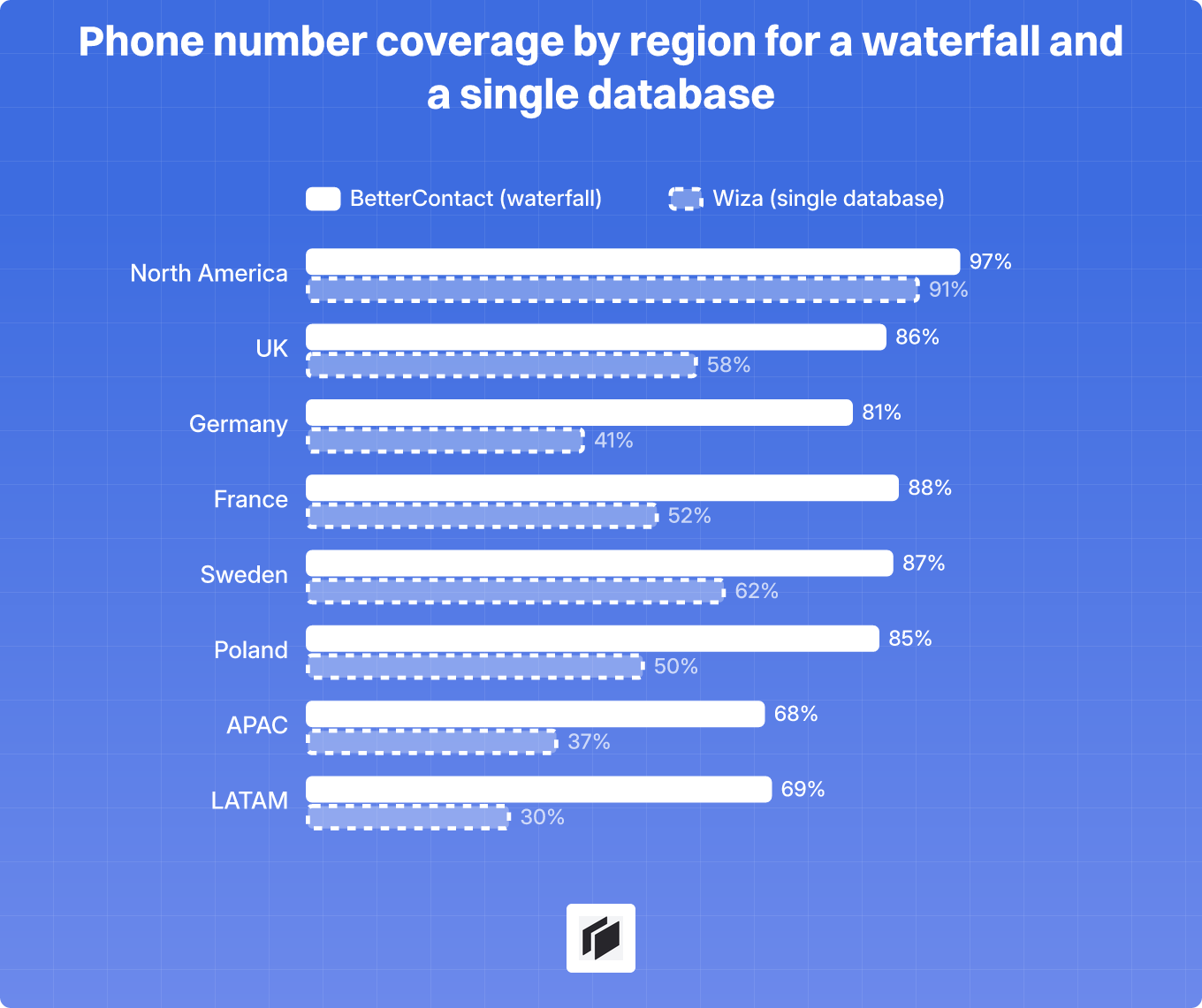
BetterContact’s lead over Wiza grows sharply outside North America. It is 6 points in North America and 40 in Germany. A single database can still win a region, as ContactOut did in LATAM, so the table matters more than the waterfall-or-not question.
What vendors publish themselves
Most vendors publish one global figure. These are the ones that give a regional or country split for phones.
| Tool | What it publishes by region | Source |
|---|---|---|
| FullEnrich | Mobile find rate: US and Canada 86%, EMEA 71%, LATAM 67%, APAC 66% | FullEnrich blog (opens in a new tab) , April 2026. Its homepage shows different figures |
| ContactOut | Phone coverage on sales leadership titles: France 88%, US 85%, UK 85%, Australia 79%, India 78%, Canada 72%, Singapore 72%, Germany 67% | ContactOut (opens in a new tab) |
| Lusha | Sales VPs and directors with a phone on record: US 81.6%, UK 70.7%, Germany 66.1%. No Italian contact data | Lusha blog (opens in a new tab) , October 2026, and FAQ (opens in a new tab) |
| ZoomInfo | Mobile numbers on file: North America 77.7M+, Europe 18.5M+, Asia 12.9M+, Australia and New Zealand 4.1M+, South America 2.3M+ | ZoomInfo data page (opens in a new tab) |
| Cognism | No phone figures by region. Claims 200M+ European contacts and phone-verified mobiles | Cognism (opens in a new tab) |
| Kaspr | No phone figures. Claims 200M+ European B2B contacts | Kaspr (opens in a new tab) |
| Datagma | No figures by country. Claims a 70% to 80% match rate in the US and Western Europe | Datagma (opens in a new tab) |
| LeadMagic | 70M+ mobiles, “USA primary coverage” | LeadMagic (opens in a new tab) |
| Apollo, BetterContact, Enrow, Wiza | No regional phone figures | Vendor sites, checked November 2026 |
ZoomInfo’s counts show the imbalance behind every table here. It holds four times as many mobile numbers for North America as for all of Europe.
Mobile, direct dial or switchboard
Buy mobiles, and ask for direct dials as a separate field. Vendors return three kinds of numbers, and they do not reach the same person.
- Mobile. The person’s own cell phone. It follows them from one job to the next, and it is the number most likely to be answered by the person you want. It may also be their personal device, which matters for the calling rules below.
- Direct dial. A desk line at the company that rings one person. It stops working when they leave. Lusha notes that desk lines at director level and above are the least likely to be answered.
- Switchboard. The company’s main number. It reaches reception or an automated menu. Apollo shows it for free, and Answrd, an outbound agency, found that senior people at small companies often come back with a switchboard only. For local businesses, see how to find a business owner’s phone number .
Call studies disagree on which number connects best, because each defines “mobile” differently. Nooks, across about 3 million dials, found that mobiles connect 45% more often (opens in a new tab) than other numbers. Klenty, across 862,616 US dials, found that main lines were answered more often (opens in a new tab) , 10.0% against 8.2%. But when a mobile was answered, the prospect was on the line 78.3% of the time, against 69.5% for main lines.
FullEnrich and BetterContact bill mobiles only, so a landline returned in their place costs nothing.
Why mobile numbers cost five to ten times an email
A work email follows a pattern that can be guessed and checked against the mail server. A mobile number has no pattern and appears on no company website. Vendors buy it from data partners and contributor networks, then check it with the carrier.
That checking throws a lot away. FullEnrich says on its homepage (opens in a new tab) that 31.53% of the data it buys fails verification. Vendors that bill only for found numbers also absorb the cost of every miss, and they price it into each hit.
The ratio shows up in the price lists. FullEnrich and BetterContact charge 10 credits for a mobile, against 1 for a work email. Apollo charges 8 credits per phone and Lusha 5, against 1 for an email. So get the email first, check that the lead fits, and only then pay for a mobile.
Cost per phone number found
Prices come from each vendor’s pricing page in November 2026. The cost per number assumes every credit goes to phones on the plan shown.
| Tool | Credits per number | Published price | Cost per number found | Billed only when found |
|---|---|---|---|---|
| LeadMagic | 5 per mobile | $99/mo for 5,000 credits | About $0.10, $0.04 on the $849 plan | Yes |
| ContactOut | ”Unlimited”, capped at 1,000 phones a month in its terms | $99/mo billed yearly | About $0.10 at the cap | Yes |
| Apollo | 8 per number | $49/user/mo billed yearly, 30,000 credits a year | About $0.16 | Per verified number |
| Wiza | 1 phone credit per contact with a number | $49/mo with 100 phones, then $0.35 each | $0.35 to $0.49 | Yes |
| Enrow | 40 per number | $17 for 1,000 credits, $87 for 10,000 | $0.35 to $0.68 | Yes |
| Datagma | Phone quota | $49/mo for 100 phones, $99 for 250 | $0.40 to $0.49 | Yes |
| Lusha | 5 per phone | $37.45/mo billed yearly, 4,800 credits a year | About $0.47 | Yes, but each API request costs at least 1 credit |
| Kaspr | 1 phone credit per lead | $49/mo billed yearly for 100 phone credits a month | About $0.49, down to $0.21 with the largest add-on | Not stated |
| BetterContact | 10 per mobile | $15/mo for 200 credits, $49 for 1,000 | $0.49 to $0.75 | Yes, landlines not billed |
| FullEnrich | 10 per mobile | $29/mo for 500 credits, $55 for 1,000 | $0.55 to $0.58, $0.32 at 100,000 credits | Yes, landlines free |
| Cognism | 1 credit per contact, mobile included | Standard plan from $12,750 a year with 5 licences | Quote only | Not published |
| ZoomInfo | Not published | Quote only | Quote only | Not published |
Sources: LeadMagic (opens in a new tab) , ContactOut (opens in a new tab) and its terms (opens in a new tab) , Apollo (opens in a new tab) , Wiza (opens in a new tab) , Enrow (opens in a new tab) , Datagma (opens in a new tab) , Lusha (opens in a new tab) , Kaspr (opens in a new tab) , BetterContact (opens in a new tab) , FullEnrich (opens in a new tab) , Cognism’s own blog (opens in a new tab) (July 2025).
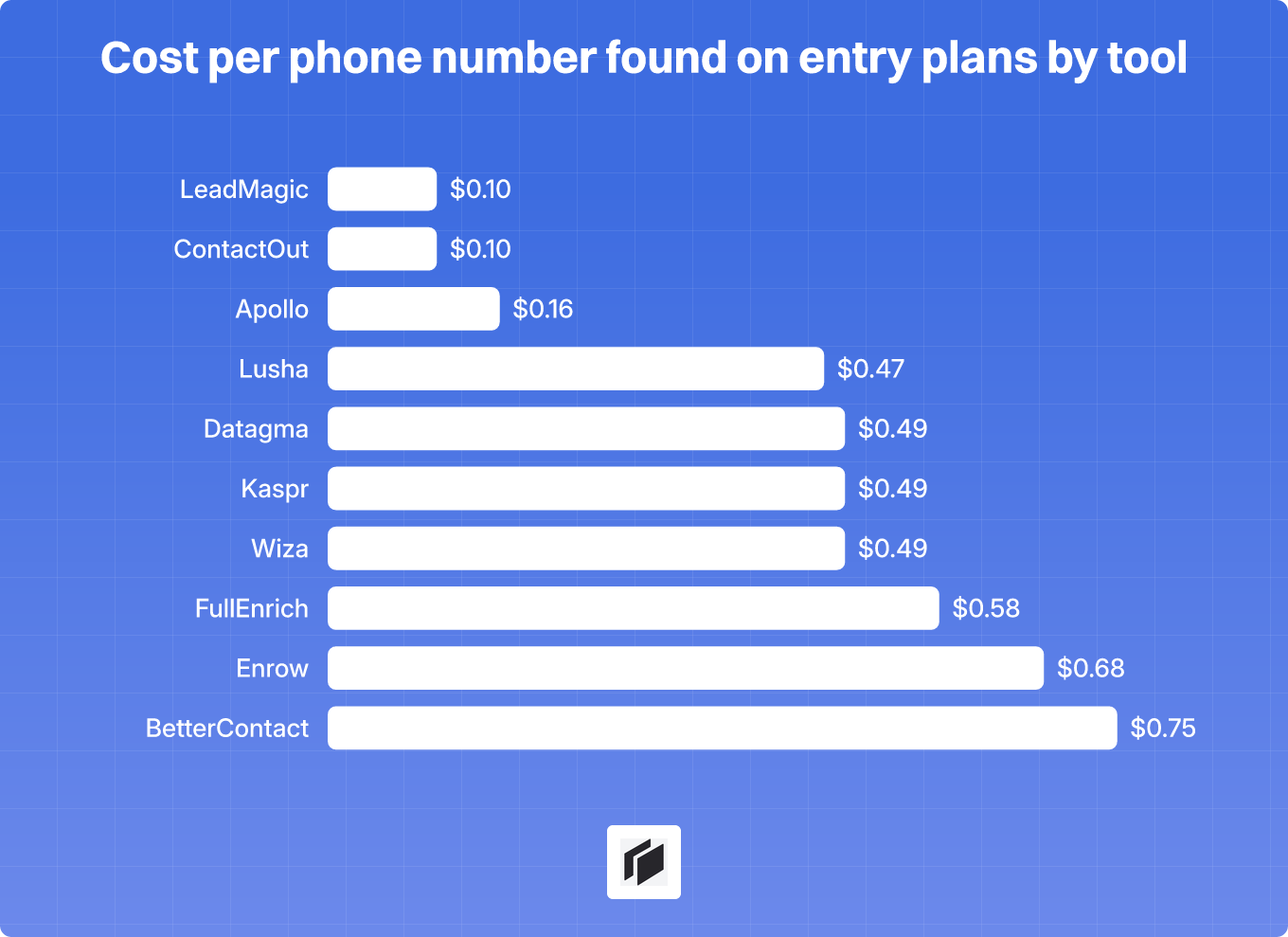
ContactOut costs a fifth of a waterfall per number, a good deal in North America, where it covers most contacts. LeadMagic is as cheap, but it found a number for less than a third of North American contacts in Clay’s test. In Germany or APAC, a cheap number you cannot find costs nothing, and gives you nothing to call.
Cost per right person reached
Price per number is the wrong unit once you start dialing. What you pay for is a conversation with the right person, so divide the price per number by the share of numbers that reach that person.
As a made-up example, a $0.10 number that reaches the right person one time in five costs $0.50 per right-person reach. A $0.55 number that reaches them three times in five costs about $0.92. The cheap tool wins on that arithmetic, unless its misses waste your reps’ time. For email pricing with the same tools, see the affordable contact enrichment tools .
How to run a phone waterfall
A phone waterfall sends each lead to a first provider, then sends only the leads it missed to the next. The mechanism is the same as for emails, explained in the waterfall enrichment guide , with a few rules of its own.
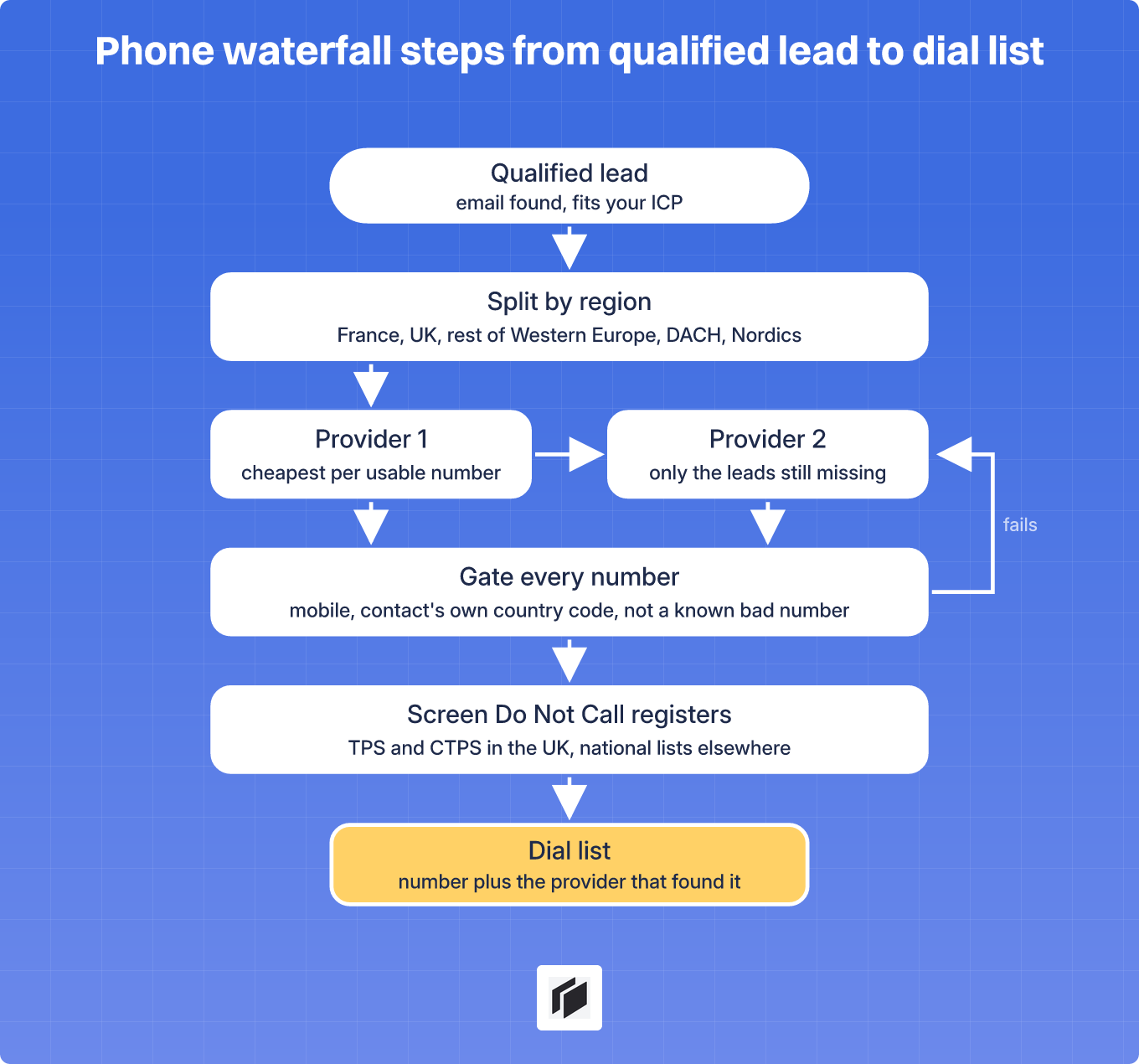
- Filter before you pay. Run the phone step after the email is found and the lead is qualified, so you only buy mobiles for people you will call.
- Split by region. Answrd recommends at least five buckets for Europe: France, the UK, the rest of Western Europe, DACH and the Nordics. Each gets its own provider order.
- Order by cost per usable number. In North America, put a cheap database first. In Germany or APAC, start with the provider that covers most, because a cheap provider that finds little only adds a step.
- Gate each answer. Keep a number only if it is a mobile, in the contact’s own country, and not on your list of known bad numbers. Answrd notes that a mobile from a neighbouring country is usually a personal phone.
- Screen before you dial. Check numbers against the Do Not Call registers that apply to each country, covered in the compliance section.
- Log the source. Record which provider found each number. You need it to cut weak providers, and to answer a prospect who asks where you got their number.
Verification and connect rates
Verification tells you a number works. It does not tell you the right person will pick up, and that gap is where most phone budgets leak.
Vendors check numbers in three ways:
- Line type and status. A carrier lookup, often called an HLR check, confirms the number is an active mobile. BetterContact runs it before billing, and FullEnrich says (opens in a new tab) its carrier checks remove up to 29% of bad numbers.
- Name match. The line owner’s name is compared with the lead. FullEnrich does it for the US and Canada only.
- Calling. Cognism’s Diamond Data team calls numbers to confirm the right person picks up. Cognism cites a study of 1,000 mobiles in which the right person answered 45% of the time on verified numbers, against 18% on standard ones. It does not name who ran the study.
Right-person rates from real dials vary widely. ContactOut reports a 63.8% right-person rate (opens in a new tab) on a sample it dialed in September 2026. Answrd’s call logs for October 2026 show Kaspr mobiles reaching the person 43% of the time in Sweden (opens in a new tab) and 42% in Denmark, against 25% in Germany, 22% in France and 21% in the UK.
Even good data connects rarely. Gong’s analysis of more than 300 million calls puts the average rep’s connect rate at 5.4% (opens in a new tab) , and the top quarter at 13.3%. Track your own rate per provider and per country, and drop the provider whose numbers your reps stop trusting.
Compliance: GDPR, EU calling rules, TCPA and Do Not Call lists
A B2B mobile number is personal data in Europe, and calling it is regulated in every region below. This is a summary of what regulators publish, not legal advice.
| Region | B2B live calls | What to screen or do | Source |
|---|---|---|---|
| EU and EEA (GDPR) | Legitimate interest can apply when the call relates to the person’s job | Tell the person where you got their data at the first contact at the latest, and stop if they object | GDPR Art. 14 and 21 (opens in a new tab) , CNIL (opens in a new tab) |
| EU calling rules | Each country chooses opt-in or opt-out for live calls. Automated calls need consent everywhere | Check the country’s own rule | ePrivacy Directive Art. 13 (opens in a new tab) |
| Germany | At least presumed consent of the business | Express consent for consumers | UWG §7 (opens in a new tab) |
| France | Opt-out for professionals when the call relates to their job | Consumers need prior consent since 11 August 2026, and Bloctel has closed | Service-Public (opens in a new tab) , CNIL |
| UK | Allowed unless the number is registered or the business objected | Screen against both TPS and CTPS, since sole traders register on the TPS | ICO (opens in a new tab) |
| USA | The FTC’s Telemarketing Sales Rule exempts most B2B calls, except sales of nondurable office or cleaning supplies | Autodialed or prerecorded calls to any mobile need prior express consent, B2B included. Scrub against the Do Not Call registry, since the status of a business mobile is not settled | FTC (opens in a new tab) , 47 CFR 64.1200 (opens in a new tab) |
Some US states add their own rules, such as Florida’s Telephone Solicitation Act. In the Nordics, the national registers cover consumers: NIX in Sweden, Reservasjonsregisteret in Norway and the Robinson list in Denmark. They matter when a work mobile is also a personal phone.
Lusha and ZoomInfo flag Do Not Call numbers on each record. Cognism says it screens against national registers in 12 named countries, including the UK’s TPS and CTPS. LeadMagic states that checking whether a number may be called is the customer’s job.
Phone number enrichment in Cockpit
Cockpit does not sell phone numbers. You plug your Apollo or Pipecorn API key into a phone column, inside the same spreadsheet where you import and qualify the leads.
- Apollo “Find phone number” asks Apollo’s people enrichment for a mobile or direct number, from an email or from a name and a company.
- Pipecorn phone finds a verified mobile through Pipecorn’s waterfall, from a LinkedIn URL.
Put both in a phone waterfall column, in the order you choose. Each attempt is recorded with its result, so you can see which provider found each number. Using your own provider keys requires the Growth plan ($79 a month for 10,000 credits) or Scale. You pay Apollo or Pipecorn directly for the numbers, at their own prices.
The coverage is the providers’ coverage. Neither Apollo nor Pipecorn was in Clay’s tests, and neither publishes phone figures by region, so check the first results on your own market. For a calling list that is mostly German or APAC contacts, the waterfall services above have stronger published results. Cockpit fits when the phone step is one part of a wider workflow.
That workflow starts with the email. Find it with Icypeas (4 credits when found), verify it with MillionVerifier (1 credit), filter on fit, then add the phone column only to the rows you will call. The contact enrichment use case shows the setup, and if Apollo is your current source, the Apollo alternatives cover other options.
FAQ
What is phone number enrichment?
It adds a mobile or direct phone number to a lead record from what you already have, usually a name and a company, an email or a LinkedIn URL. It is used to build calling lists for B2B outbound.
Which enrichment API has the best mobile phone coverage?
In Clay’s October 2025 tests, BetterContact, a waterfall, had the highest coverage of the five tools in the table in every region except LATAM, where ContactOut led, and the Middle East and Africa, where FullEnrich led with 65%. In North America, single databases came within a few points of BetterContact.
Enrow or FullEnrich for bulk email and mobile enrichment?
FullEnrich for mobiles. It publishes regional find rates and covered 58% to 81% of contacts across the European countries in Clay’s test. Enrow publishes no phone coverage and reached 23% to 43% in the regions where it was tested. On price, Enrow costs $0.68 per number on its entry plan against $0.58, and $0.35 on its $87 plan, while FullEnrich drops to $0.32 at 100,000 credits.
Is it legal to cold call B2B mobile numbers in Europe?
In opt-out countries such as France, yes, when the call relates to the person’s job, you tell them where you got their number, and you stop when they object. Germany requires at least presumed consent from the business. The UK requires screening against the TPS and CTPS.
How much should a B2B mobile number cost?
About $0.10 to $0.75 per number found on entry plans, and as little as $0.04 at volume. The US-first databases sit at the low end and the waterfalls at the high end. Cognism and ZoomInfo sell annual contracts.
What is the best phone enrichment tool for Europe?
BetterContact. In Clay’s Europe test, it found a mobile for 86% of contacts, against 56% for Wiza. Split Europe by country, since Germany and Austria are much harder than France or the Nordics.