
Most teams don’t leave Apollo because it’s bad. They leave because one thing stopped working for them.
For some it’s bounced emails. For others it’s the per-seat bill, weak coverage in Europe, or a database that misses too many of their leads. Each problem has a different fix, so the best replacement depends on which one you have.
This list is sorted by the reason you’re leaving. Short answer: Hunter or Snov.io if price is the issue, Cognism for European data, a waterfall such as Cockpit or FullEnrich if Apollo doesn’t find enough of your contacts, and ZoomInfo if you have an enterprise budget.
Why teams look for Apollo alternatives
Apollo.io is a contact database with a sequencer attached. It claims 240M contacts and 30M companies, and it bundles search, email reveals, sequences and a dialer in one app. That bundle is why it stays the default for startups.
These are the reasons people still switch, with the source for each.
- Data accuracy. In G2’s review summary (opens in a new tab) , the most cited con is outdated or inaccurate contact records, with 225 mentions, even though Apollo keeps a 4.7/5 average. On Reddit, an agency running outbound for six clients (opens in a new tab) reported bounce rates rising from 8% to 13% in early 2026.
- Coverage outside the US. Big databases lean American. ZoomInfo’s own figures list 157.8M contacts in North America against 66M in Europe (opens in a new tab) . In a UK recruitment thread (opens in a new tab) , a commenter put the connect rate on Apollo’s UK mobiles at “maybe 40%”.
- Credits that run out or expire. On Apollo’s credits page (opens in a new tab) , an email costs 1 credit and a phone number 8. Credits expire at the end of each billing cycle and do not roll over.
- Plan limits. The free plan (opens in a new tab) includes 900 credits per seat per year and lets you select 25 records at a time. Basic caps sending at 250 emails a day and selection at 1,000 records.
- Seat pricing. Paid plans cost $49, $79 and $119 per seat per month, billed yearly, and Organization needs at least three seats. G2 reviewers flag cost 75 times, particularly for individuals and small teams.
- One database’s coverage. Apollo’s paid plans include waterfall enrichment (opens in a new tab) , which checks Apollo first and then the third-party sources you connect. Each source that returns data charges credits, and the run keeps going until it finds a validated result, so one contact can be charged by more than one source.
Accuracy and seat costs are the two complaints that come back most. If you mainly weigh Apollo against Clay, our Clay vs Apollo comparison goes deeper on both.
Apollo alternatives compared
| Tool | Best for | Starting paid price | Pricing model | Main limit |
|---|---|---|---|---|
| Apollo.io (reference) | Database plus sequencer in one app | $49/seat/mo, billed yearly | Per seat plus credits | Accuracy complaints, credits expire |
| Hunter | Cheap verified emails with simple sequences | $34/mo yearly ($49 monthly) | Shared credits, unlimited users | No phone numbers |
| Snov.io | Email and LinkedIn outreach on a small budget | $29.25/mo yearly ($39 monthly) | Credits plus recipients, unlimited users | 1,000 credits go fast |
| lemlist | A sequencer with a lead database | $55/mo yearly ($69 monthly), data add-on from $16 | Plan plus data credits | Small data volumes |
| Cognism | European data and verified mobiles | On request | Packages with 5 seats, credits per contact | No public price |
| Cockpit | An email waterfall with Icypeas and your own Apollo key, in a spreadsheet | $29/mo, $79 with your own provider keys | Credits, charged on success | No database to browse, no sending |
| FullEnrich | Emails and mobiles for a list you already have | $29/mo ($26 yearly) | Credits, charged on success | No sourcing |
| Clay | Custom workflows across 150+ providers | $185/mo ($167 yearly) | Data Credits plus Actions | Learning curve and price |
| Kaspr | LinkedIn prospecting with European contacts | $49/user/mo yearly ($65 monthly) | Per user, phone credits capped | Per-user pricing |
| Lusha | Phone numbers from a browser extension | $37.45/mo, billed yearly | Credits, email 1 and phone 5 | High cost per email |
| ZoomInfo | Enterprise coverage and intent data | On request | Licenses plus credits | No public price |
Here is what one found work email costs on each entry plan, if you use every credit. Apollo’s own credits are among the cheapest emails on this list, so switching rarely saves money on email volume alone.
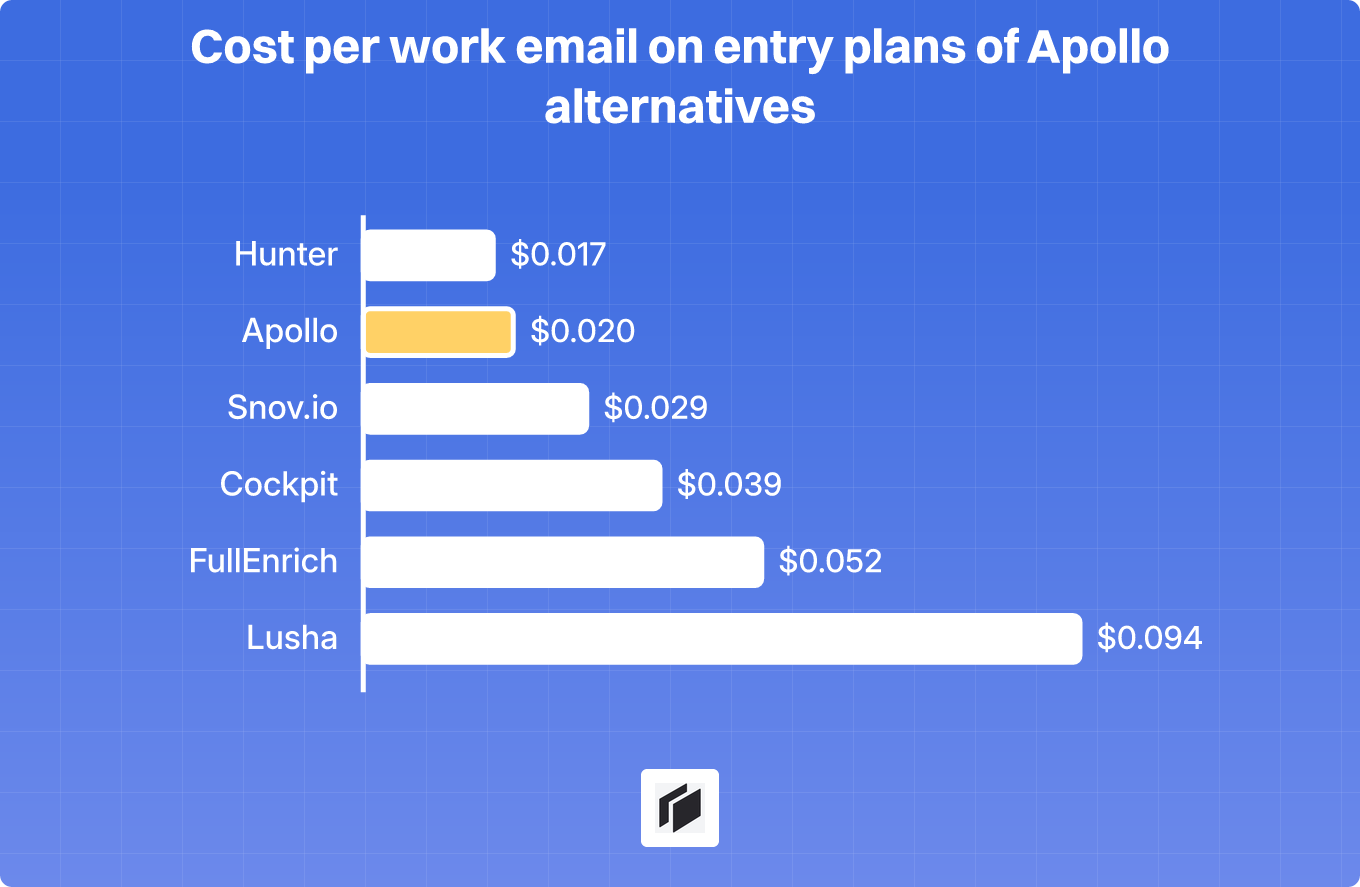
Each figure is the plan price divided by the emails its credits buy, on the cheapest billing each vendor shows. Cockpit’s figure is an Icypeas lookup at 4 credits on the $29 plan. Verification costs one more credit on Snov.io and on Cockpit, while Hunter’s credit already includes it.
Two tools are missing from the chart. Kaspr’s paid plans include unlimited B2B emails. lemlist sells data only on top of a sending plan, and $55 plus $16 for 400 emails comes to about $0.18 each.
Cheaper all-in-one alternatives to Apollo
These three replace Apollo’s database and its sequencer, and none of them charges per user on its entry plan. For a team of three, per-seat pricing is where Apollo gets expensive.
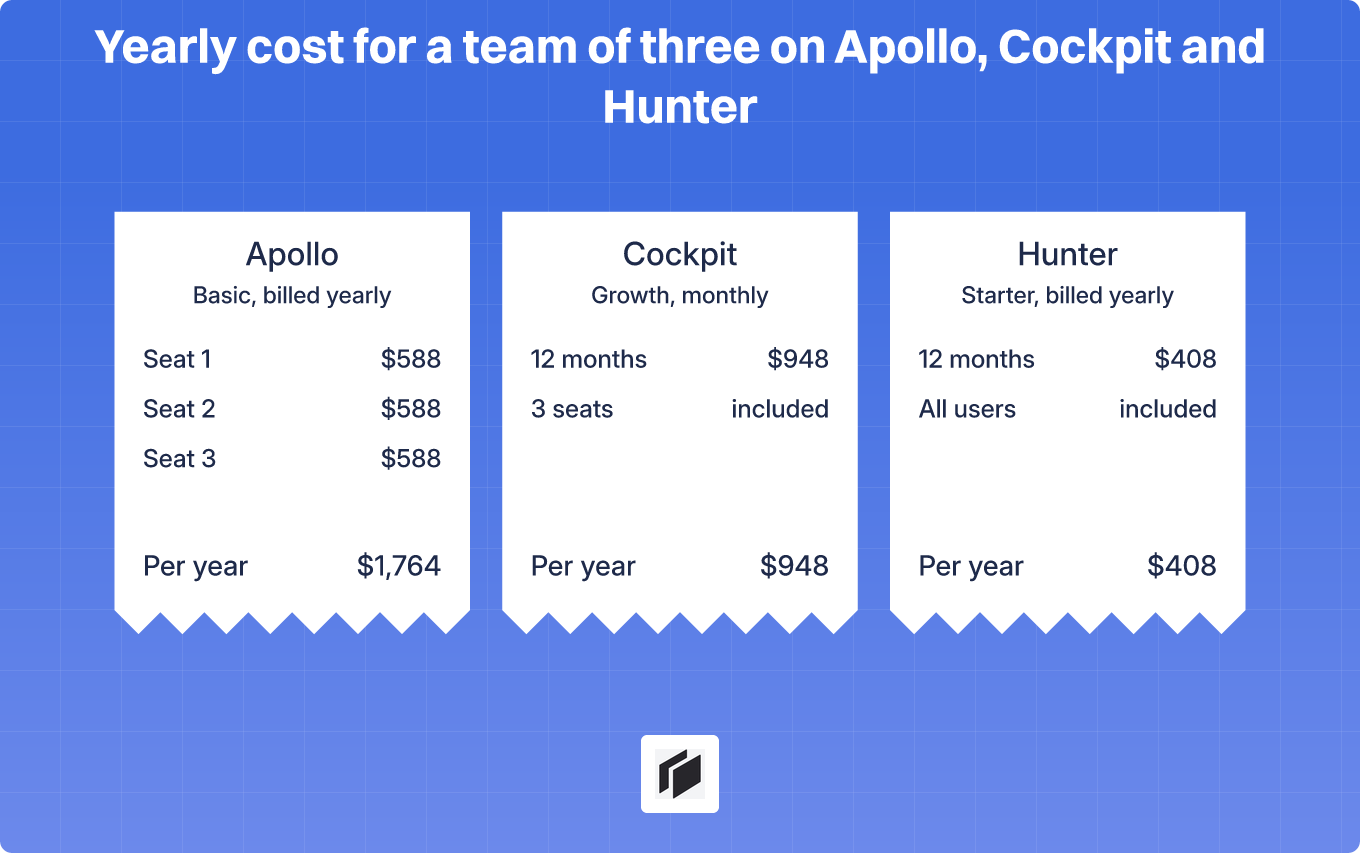
The plans don’t include the same volume. Three Apollo Basic seats come with 90,000 credits a year, Cockpit Growth with 120,000 (about 30,000 Icypeas emails), and Hunter Starter with 24,000. A team that reveals thousands of emails a month may still pay less per email on Apollo.
1. Hunter
Hunter (opens in a new tab) started as a domain search tool and is now a small outreach platform. It has a B2B database called Discover, an email finder and verifier, and sequences sent from your own mailboxes.
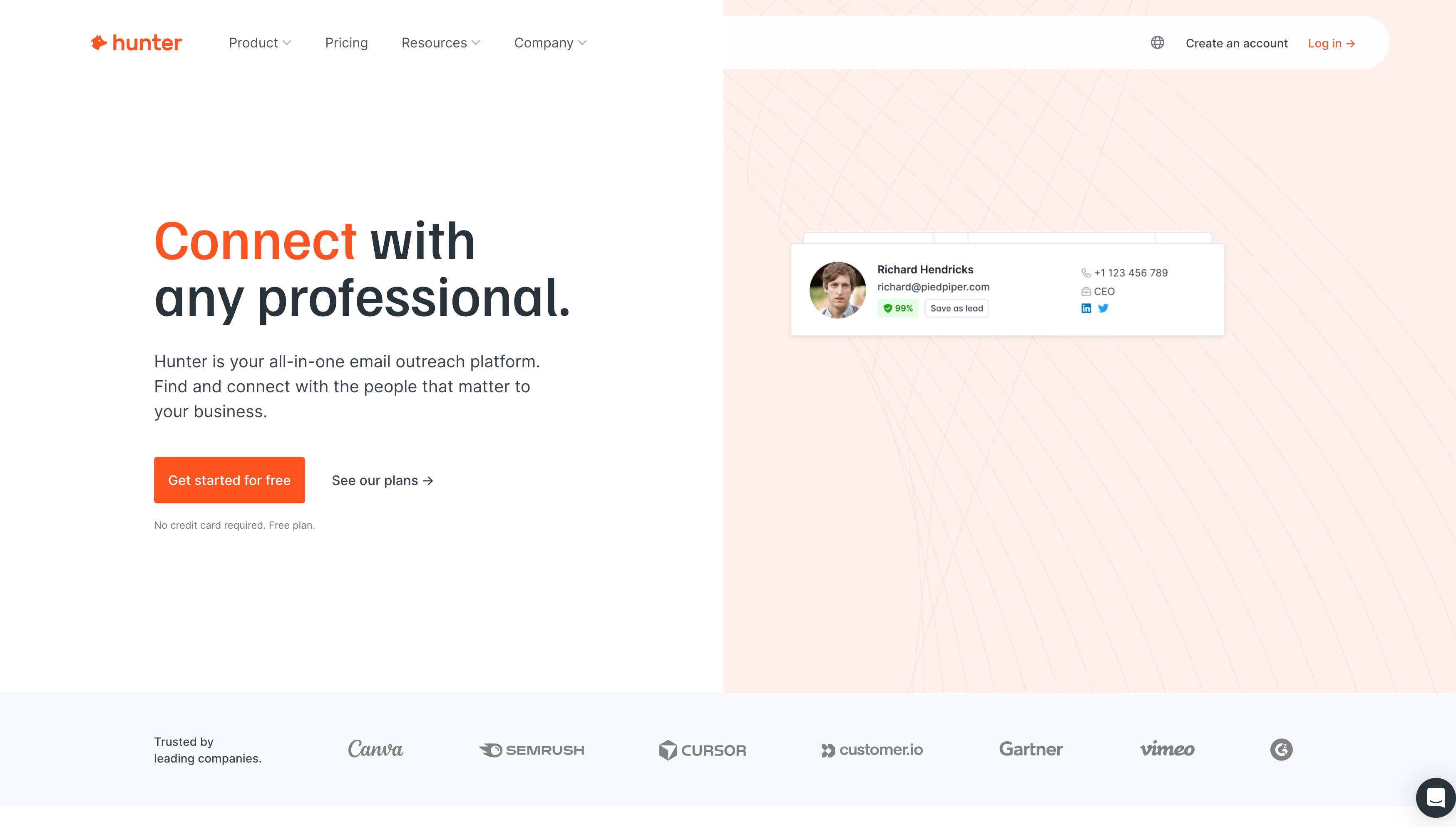
- Best for: founders who write to companies by domain and only need verified emails.
- Pricing (checked November 21, 2026): free plan with 50 credits a month. Starter is $49 a month, or $34 billed yearly, for 2,000 credits a month. One credit is one found email, and searches that find nothing are free, per Hunter’s pricing page (opens in a new tab) . Every plan includes unlimited users.
- Main limit: no phone numbers, and Starter connects only three email accounts for sequences.
2. Snov.io
Snov.io (opens in a new tab) bundles a prospect database, an email finder and verifier, warm-up, email and LinkedIn campaigns, and a light CRM.
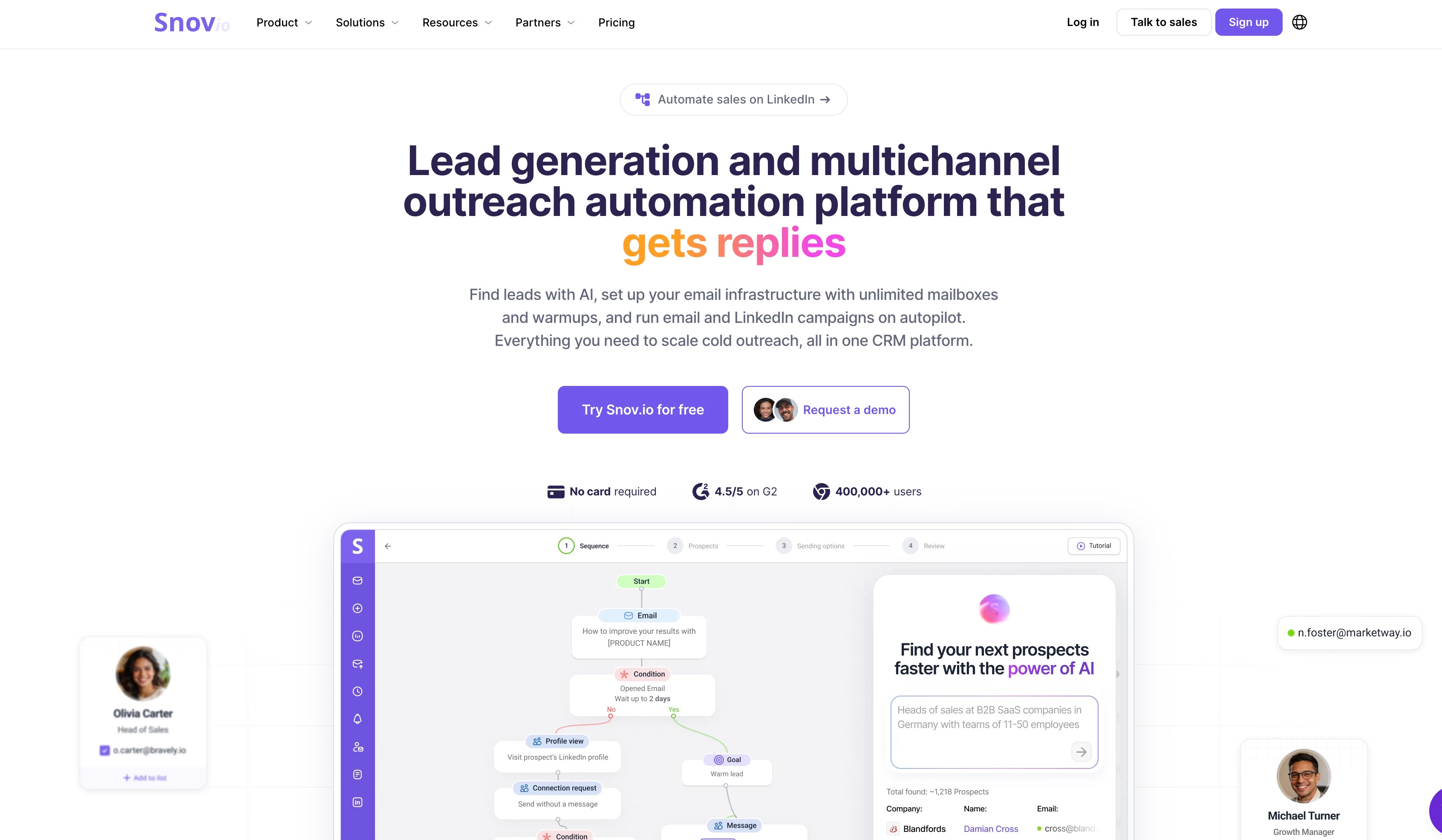
- Best for: small teams that want email and LinkedIn outreach in one cheap subscription.
- Pricing (checked November 21, 2026): Starter is $39 a month, or $29.25 billed yearly, with 1,000 credits, 5,000 recipients and unlimited users, per Snov.io’s pricing page (opens in a new tab) . Snov.io says a credit costs 3.9¢ on Starter and about 0.9¢ on larger plans.
- Main limit: each prospect and each verification uses a credit, so 1,000 credits cover only a few hundred verified leads.
3. lemlist
lemlist (opens in a new tab) is a sequencer first, with a 650M+ lead database and an email and phone finder added on.
- Best for: teams that care most about sending and want lead data in the same tool.
- Pricing (checked November 21, 2026): the Email plan is $69 a month, or $55 billed yearly, with unlimited users and 50,000 emails a month. Multichannel, with LinkedIn steps, is $109 per user, or $87 yearly. Contact data is an add-on at $20 a month, or $16 yearly, for 2,000 credits, which buys 400 emails or 100 phone numbers, per lemlist’s pricing page (opens in a new tab) .
- Main limit: the data add-on is small. A team that needs thousands of contacts a month will pair lemlist with another data source.
Better data accuracy and EU coverage
4. Cognism
Cognism (opens in a new tab) markets itself on European data. Its main asset is Diamond Data, mobile numbers that its team has checked by phone.
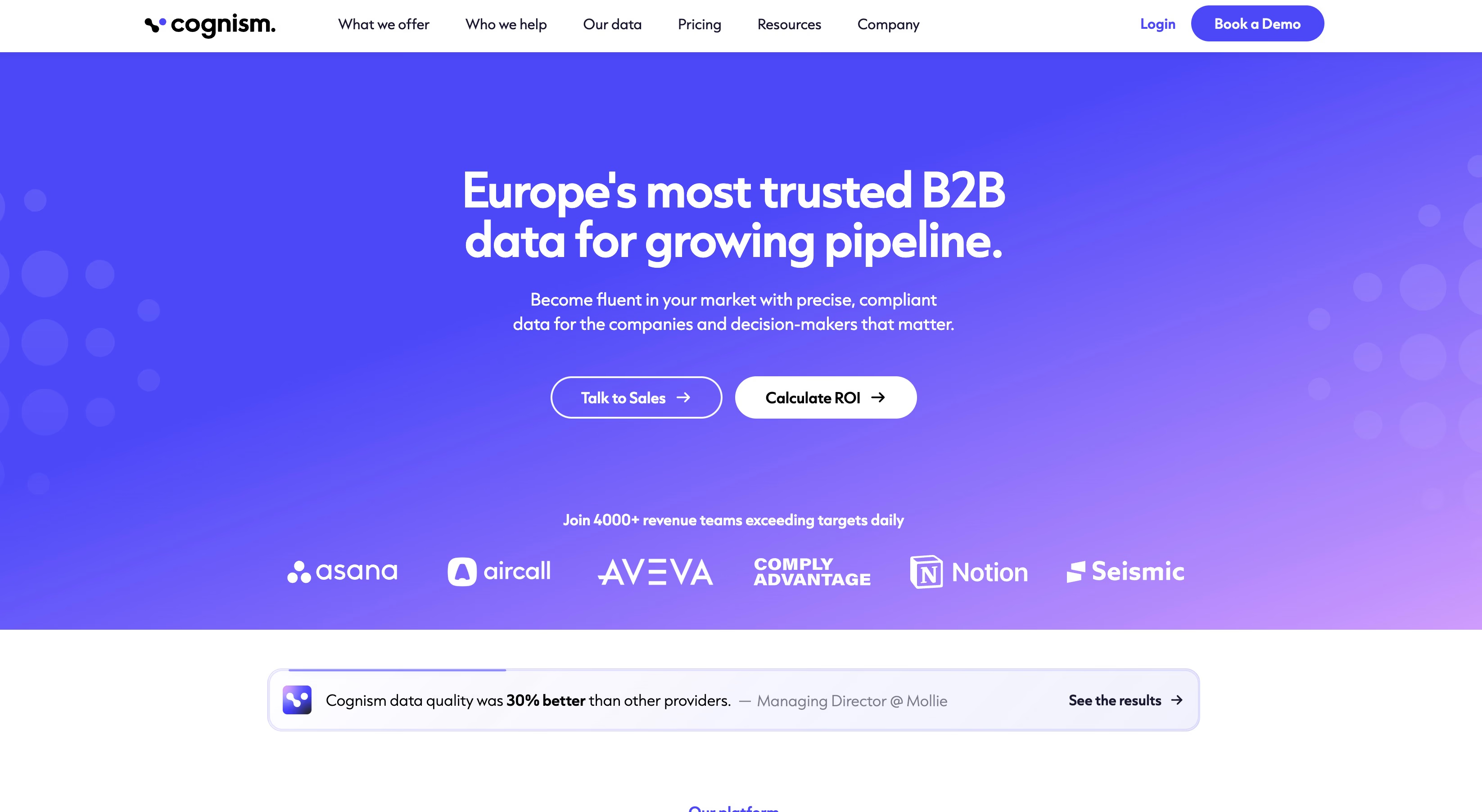
- Best for: SDR teams that call into the UK and Europe and need mobiles that connect.
- Pricing (checked November 21, 2026): not published. Cognism’s pricing page (opens in a new tab) lists two prospecting packages, Standard and Pro, each with five seats, and one credit per revealed contact. The agency in the Reddit test above put Cognism at $1,000 to $3,000 a month, with a 2.4% bounce rate.
- Main limit: a sales-led purchase sized for teams, not for a founder testing outbound.
Cognism bought Kaspr in 2022 (opens in a new tab) , and Kaspr, in the LinkedIn section below, is the self-serve way to get European contacts. If your bounces come from US contacts, a waterfall with verification is the cheaper fix.
Apollo alternatives for contact and data enrichment
These tools use waterfall enrichment. A waterfall asks several providers in turn for the same email or phone number and stops when one finds it. Each provider covers different people, so the waterfall finds contacts that one database misses. Our guide to waterfall enrichment explains the logic and the costs.
None of them replaces Apollo’s search. You bring the list, from LinkedIn, a CSV or a CRM, and they find the contact data.
5. Cockpit
Cockpit is a spreadsheet for lead enrichment. Apollo is one of its providers, through your own Apollo API key, and you chain it with other email finders in a waterfall column.
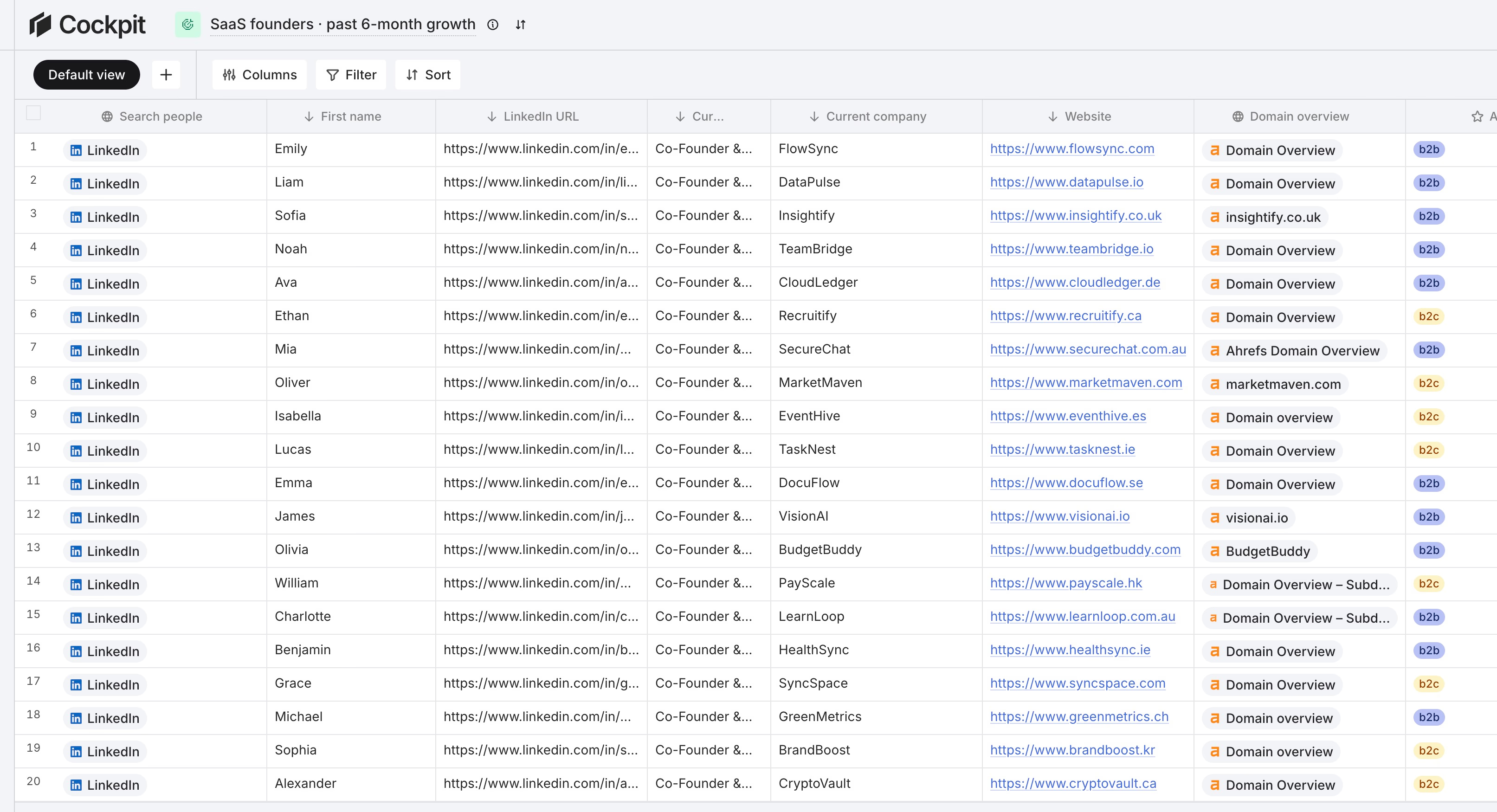
How it works:
- Import. Rows come from a LinkedIn people or company search, the reactors and commenters of LinkedIn posts, Google Maps, a CSV, or HubSpot, Pipedrive and Attio.
- Waterfall. An email or phone column runs at least two providers in the order you choose and stops at the first one that finds a value. Cockpit only charges credits for a lookup that finds something.
- Providers. Icypeas finds emails on Cockpit credits. Apollo, Hunter, Prospeo and Pipecorn run on your own API keys, on the Growth plan and above. The provider bills those lookups on your account with them, and Cockpit uses 1 credit per successful call.
- Verify and write. MillionVerifier checks emails. AI columns and an AI web research agent add context to each row, and sequence columns write the messages.
- Export. Send rows and sequences to Lemlist or Instantly, or download a CSV.
A typical email waterfall puts Icypeas first, at 4 credits per found email, then your Apollo key on the rows Icypeas missed. Apollo bills those lookups at 1 credit per email on your Apollo plan. For phone numbers, plug your Apollo or Pipecorn key into a phone column or a phone waterfall .
- Best for: founders and small teams who source on LinkedIn and want more contacts found than one database gives, next to their AI research.
- Pricing: $29 a month for 3,000 credits and one seat, $79 for 10,000 credits and three seats, and $199 for 30,000 credits and ten seats, with a 14-day trial. Saved provider keys, and so a waterfall with Apollo, need the $79 plan or above, like exports to Lemlist or Instantly. See pricing .
- Main limit: Cockpit is not a contact database you browse like Apollo, and it has no built-in sender or dialer. It does not sell phone numbers on its own credits, so you need an Apollo or Pipecorn account for those.
6. FullEnrich
FullEnrich (opens in a new tab) is a waterfall tool for emails and mobile numbers. You upload a list and it checks a stack of providers for each contact.
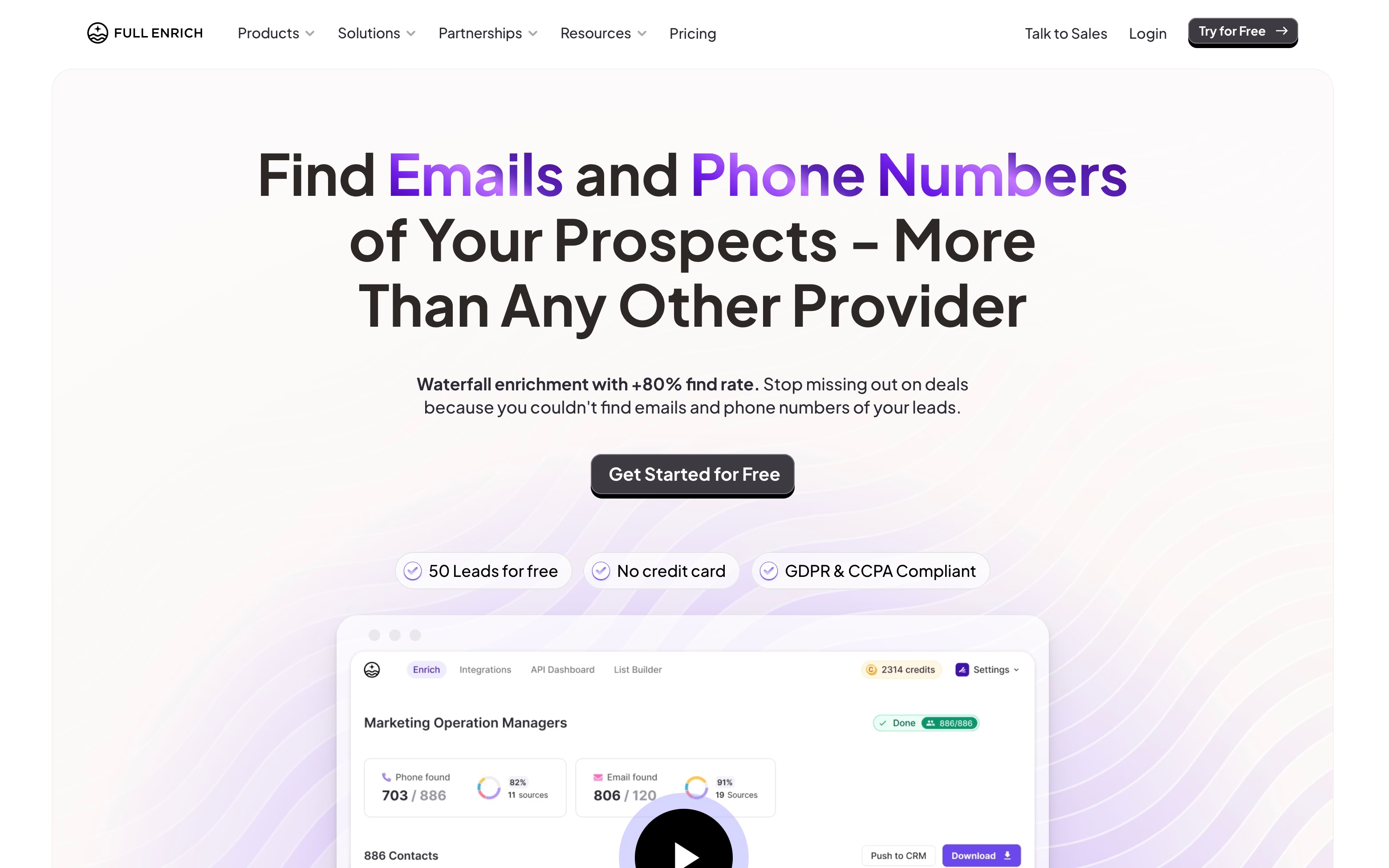
- Best for: teams that need mobile numbers for a list they already have, without managing provider accounts.
- Pricing (checked November 21, 2026): $29 a month for 500 credits, or $26 billed yearly. A work email is 1 credit, a personal email 3 and a mobile 10, and you only pay for verified data, per FullEnrich’s pricing page (opens in a new tab) .
- Main limit: it finds contact data and does nothing else, with no search and no sequencer. Our FullEnrich vs Clay comparison covers where it fits.
7. Clay
Clay (opens in a new tab) is the best-known enrichment workbench. It has no database of its own and connects to 150+ providers, Apollo included, with waterfalls, conditions and an AI agent.
- Best for: teams with a GTM engineer who need data Apollo doesn’t have, such as tech stack or hiring.
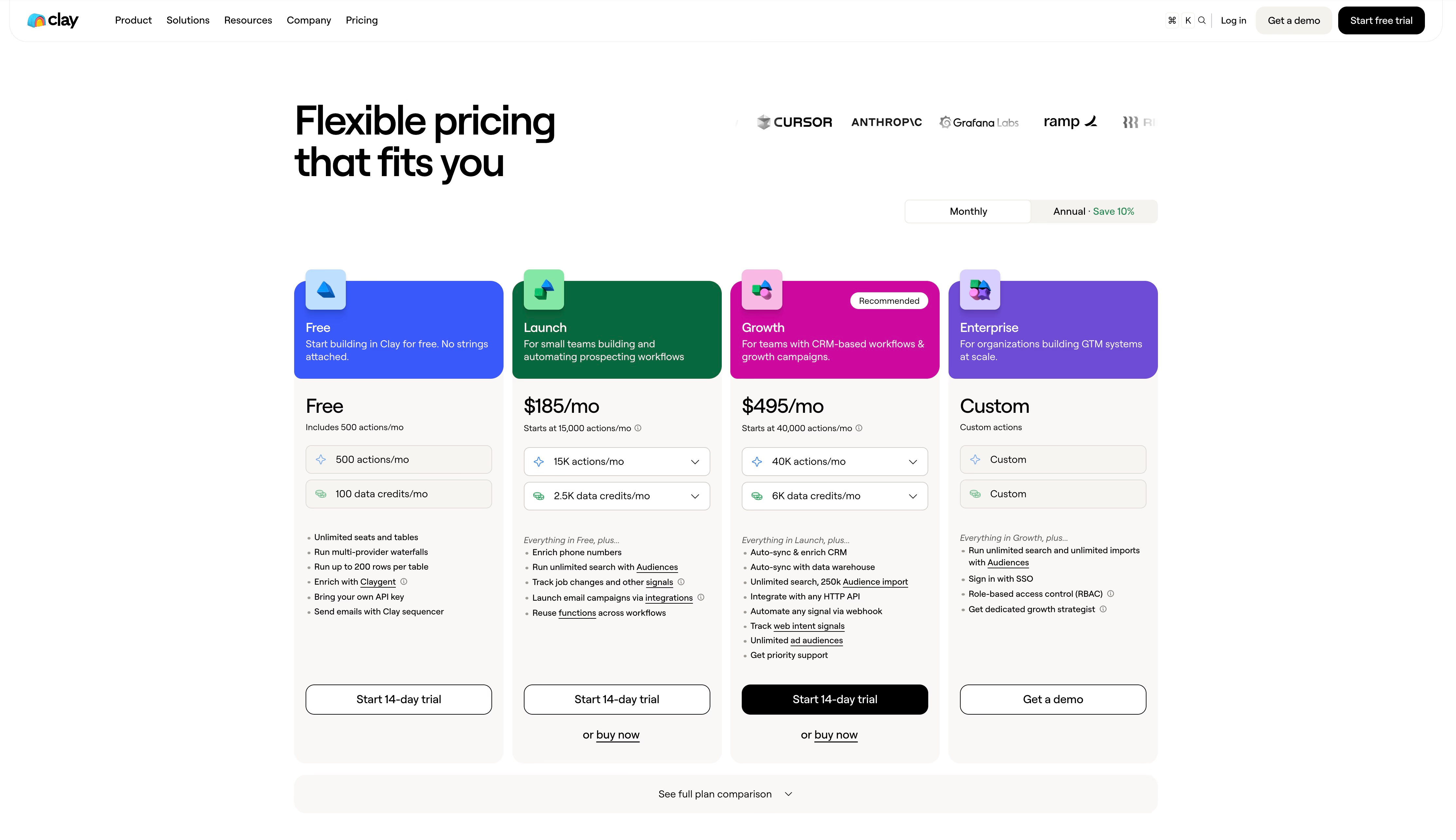
- Pricing (checked November 21, 2026): free plan with 100 Data Credits. Launch starts at $185 a month, or $167 billed yearly, with 2,500 Data Credits and 15,000 Actions. Growth starts at $495 a month, per Clay’s pricing page (opens in a new tab) .
- Main limit: the learning curve and two usage meters. Our Clay pricing guide breaks down what a lookup really costs.
LinkedIn-first prospecting
If you build lists from LinkedIn rather than from a database search, these tools find the contact details from a profile or a Sales Navigator search. They fit reps who prospect one profile at a time.
8. Kaspr
Kaspr (opens in a new tab) is a Chrome extension that shows emails and phone numbers on LinkedIn profiles, Sales Navigator, groups and events, and enriches LinkedIn searches in bulk.
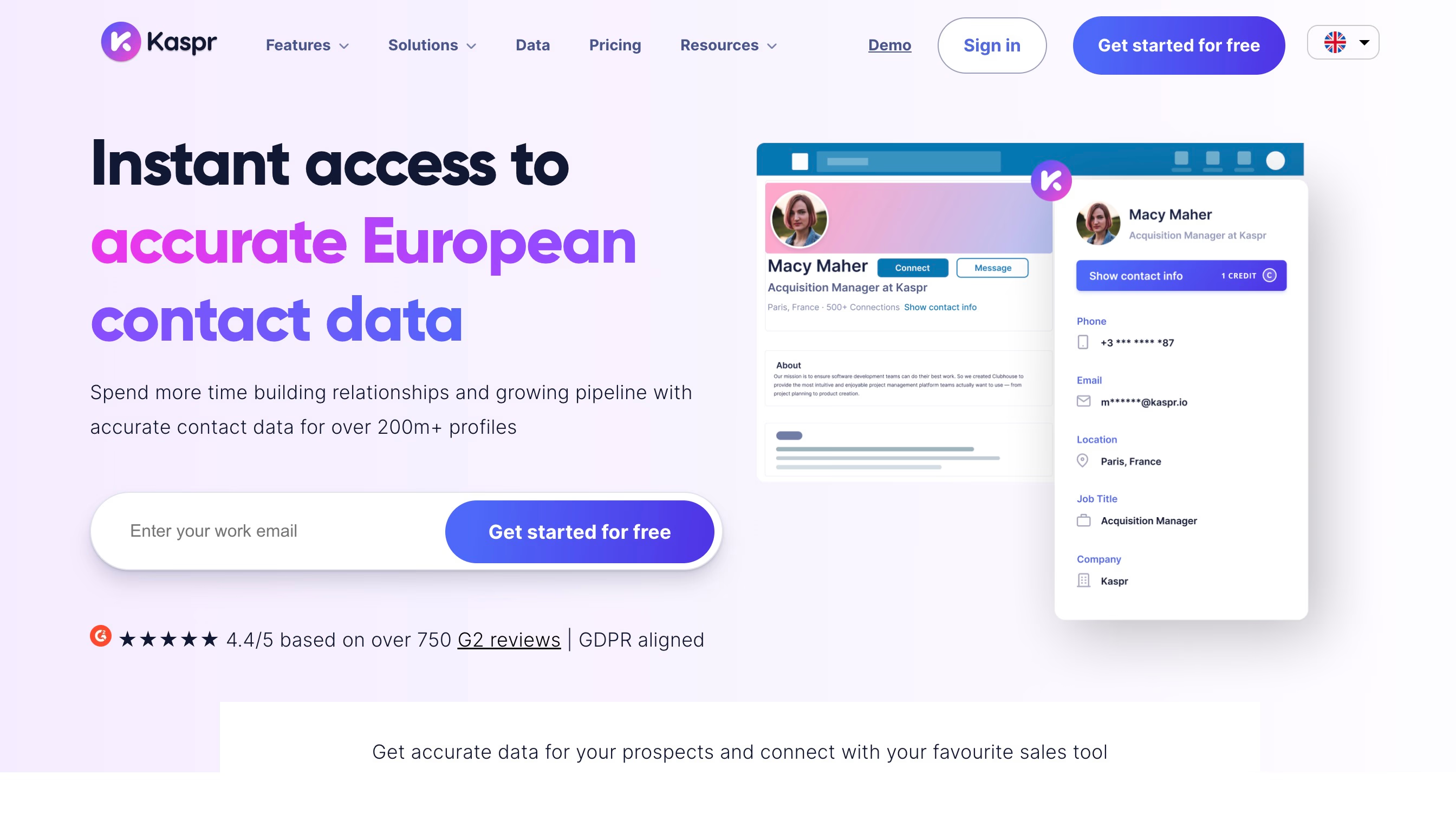
- Best for: reps and recruiters who prospect on LinkedIn and target European contacts.
- Pricing (checked November 21, 2026): free plan with 15 B2B email credits, 5 phone credits and 5 direct email credits a month. Starter is $49 per user per month billed yearly, or $65 monthly, with unlimited B2B emails, 1,200 phone credits a year and up to 12,000 exports a year. Business is $79 yearly or $99 monthly, per Kaspr’s pricing page (opens in a new tab) .
- Main limit: pricing is per user, and phone credits are capped well below what a calling team uses.
9. Lusha
Lusha (opens in a new tab) is a contact database with a browser extension that shows emails and phone numbers while you browse LinkedIn or a company site.
- Best for: sales reps who need direct phone numbers.
- Pricing (checked November 21, 2026): free plan with 40 credits a month. Starter is $37.45 a month billed yearly for 4,800 credits a year, and Pro is $52.45 for 7,200. An email costs 1 credit and a phone 5, per Lusha’s pricing page (opens in a new tab) .
- Main limit: about $0.09 per email on Starter. In the agency test above, Lusha also returned 60% to 70% fewer contacts than Apollo for the same filters.
Enterprise data
10. ZoomInfo
ZoomInfo (opens in a new tab) is built for enterprise go-to-market teams. It lists 500M+ contacts and 100M+ company records (opens in a new tab) , with intent signals on 4,500+ topics.
- Best for: large sales and marketing teams that want contact data and intent under one contract.
- Pricing (checked November 21, 2026): not published. ZoomInfo’s pricing page (opens in a new tab) says packages depend on features, licenses and credits, and a credit is used each time a contact or company is exported.
- Main limit: the price and the sales process put it out of reach for small teams. It only makes sense when data is a line in a large budget.
Which Apollo alternative should you choose?
Start from the problem that made you look.
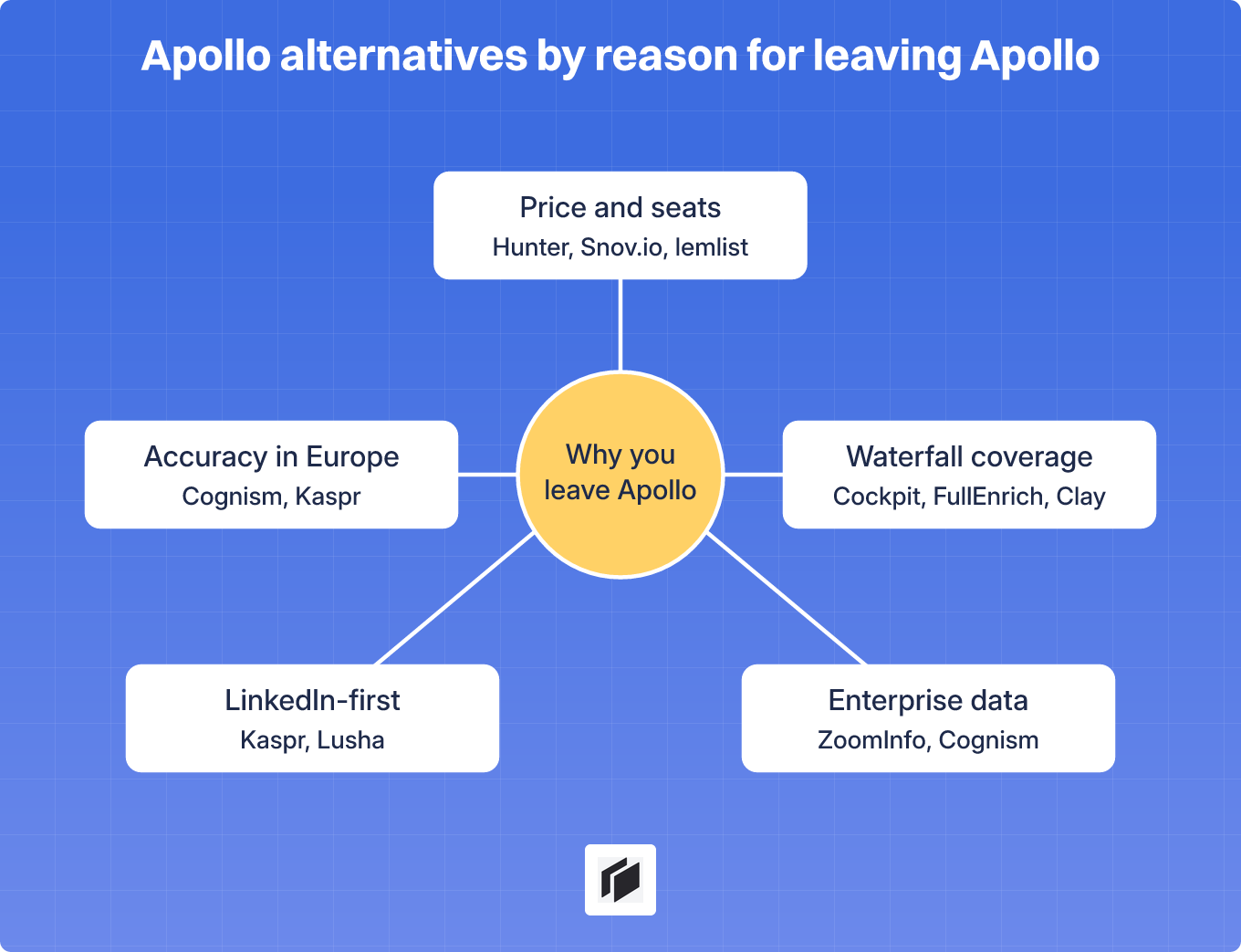
- Your bill grows with every seat. Take Hunter if you only need emails, Snov.io if you also want LinkedIn steps, or lemlist if sending matters most.
- Your emails bounce or your European mobiles don’t connect. Pick Cognism if you have the budget, Kaspr if you prospect on LinkedIn.
- Apollo doesn’t find enough of your contacts. Add a waterfall. Cockpit if you also source on LinkedIn and write with AI in the same sheet, FullEnrich for a list you already have, Clay if a GTM engineer will build the workflow.
- You need an enterprise contract. Go to ZoomInfo or Cognism.
Our pick for a team of one to three depends on one question. If Apollo’s search still finds your targets, keep one Apollo seat and run enrichment in a Cockpit waterfall, with Icypeas first and your Apollo key on the misses. Apollo lists API enrichment from its Basic plan, and Cockpit’s $79 plan covers three people.
If you’d rather leave Apollo entirely and keep search and sending in one app, Snov.io is the cheapest full replacement. For more tools ranked by cost per email, see our lead enrichment tools comparison.
Apollo alternatives FAQ
What is the best free alternative to Apollo.io?
Hunter, for emails. Its free plan gives 50 credits a month and includes sequences. Kaspr’s free plan suits LinkedIn prospecting, with 15 B2B emails and 5 phone numbers a month, and Lusha gives 40 credits. None of them matches the search in Apollo’s own free plan.
What is the cheapest alternative to Apollo?
Snov.io at $29.25 a month billed yearly, or Hunter at $34, both with unlimited users. Per email, Hunter Starter works out to about $0.017 on yearly billing, slightly below Apollo Basic at about $0.020.
How does Apollo compare with ZoomInfo, HubSpot and LeadIQ for B2B data enrichment?
ZoomInfo has a larger database and more intent data, sold through custom contracts. HubSpot’s data enrichment (opens in a new tab) fills properties from a name and work email you already have, so it does not find the email for you.
LeadIQ is a prospecting tool built around a Chrome extension, with a free plan and a 30-day trial. Apollo sits between them, as a self-serve database that finds emails and phones and enriches CSVs and CRMs. For the CRM side, see our guide to CRM data enrichment .
Is Apollo’s data accurate in Europe?
It’s weaker than in the US by most user accounts, with stale records and lower connect rates on UK mobiles. If Europe is your main market, test Cognism or Kaspr on 100 of your own contacts before you commit.
Can I keep Apollo and add another tool?
Yes, and for many teams it’s the best setup. Keep Apollo for search and sequences, and run your lists through a waterfall that tries other providers before or after Apollo. Clay has a native Apollo integration, and Cockpit runs Apollo with your own API key inside its waterfall columns.