
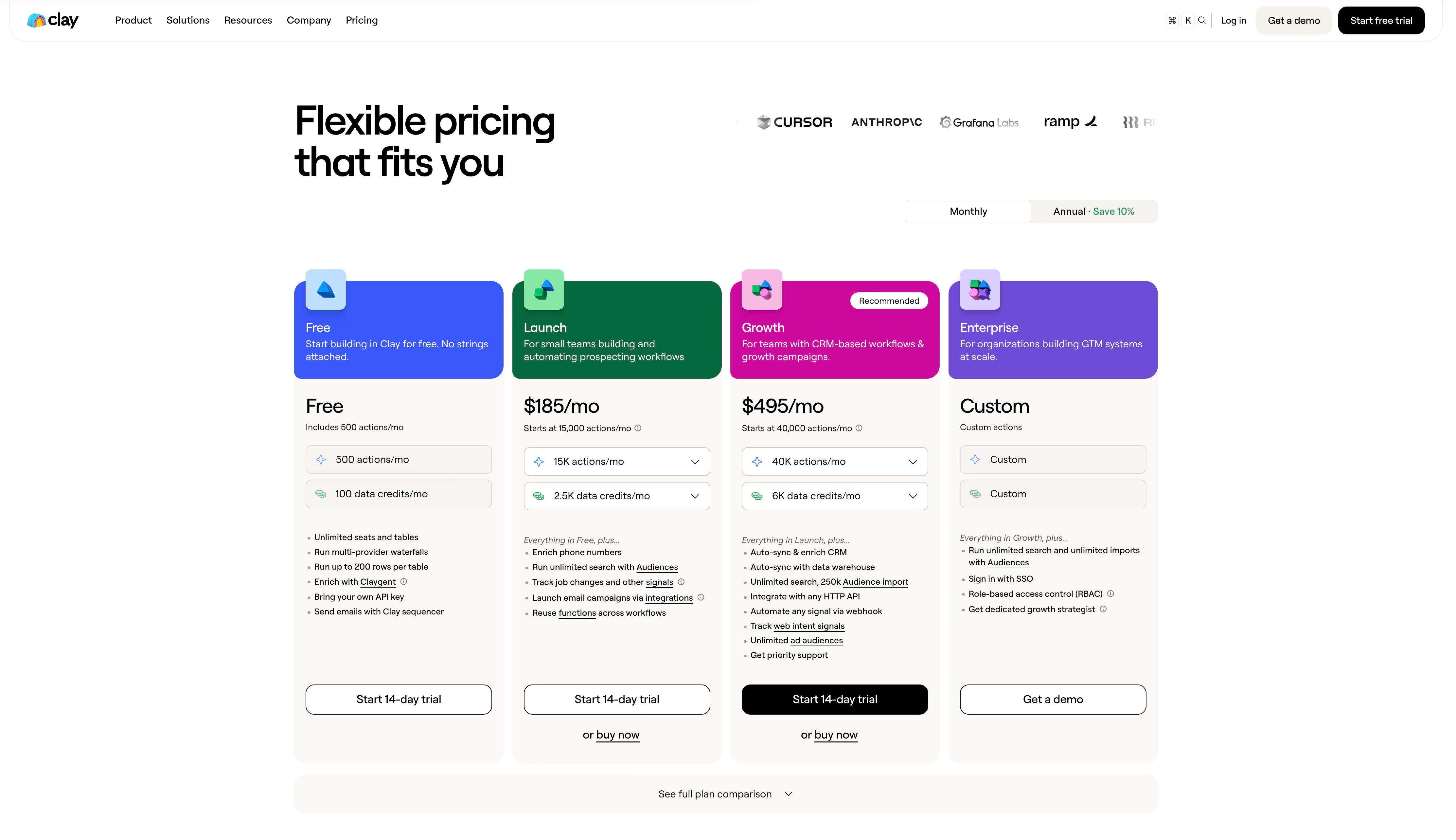
Clay has four plans. Free costs $0, Launch costs $185 a month ($167 billed yearly), Growth costs $495 ($446 yearly) and Enterprise is quoted case by case.
Each plan includes two allowances, Actions for the work Clay does and Data Credits for the data it buys. What you enrich decides how fast they run out, so a lead can cost a few cents or a few dollars.
Clay pricing plans at a glance
| Plan | Billed monthly | Billed yearly | Data Credits per month | Actions per month | What it adds |
|---|---|---|---|---|---|
| Free | $0 | $0 | 100 | 500 | 200 rows per table, no phone numbers |
| Launch | $185 | $167 | 2,500 | 15,000 | Phone numbers, signals, scheduled runs, 50,000 rows per table |
| Growth | $495 | $446 | 6,000 | 40,000 | CRM sync, HTTP API, webhooks, web intent signals, ad audiences |
| Enterprise | Custom | Custom | 100,000+ | 200,000+ | Bulk enrichment, warehouse sync, SSO, dedicated strategist |
Every plan includes unlimited seats and tables, multi-provider waterfalls, Claygent (Clay’s AI research agent) and the option to bring your own API keys. A team of five pays what a team of one pays for the same volume.
Clay introduced the Actions and Data Credits split in March 2026, according to coverage at the time, so older pages quoting single-credit tiers are out of date.
How Clay Actions and Data Credits work
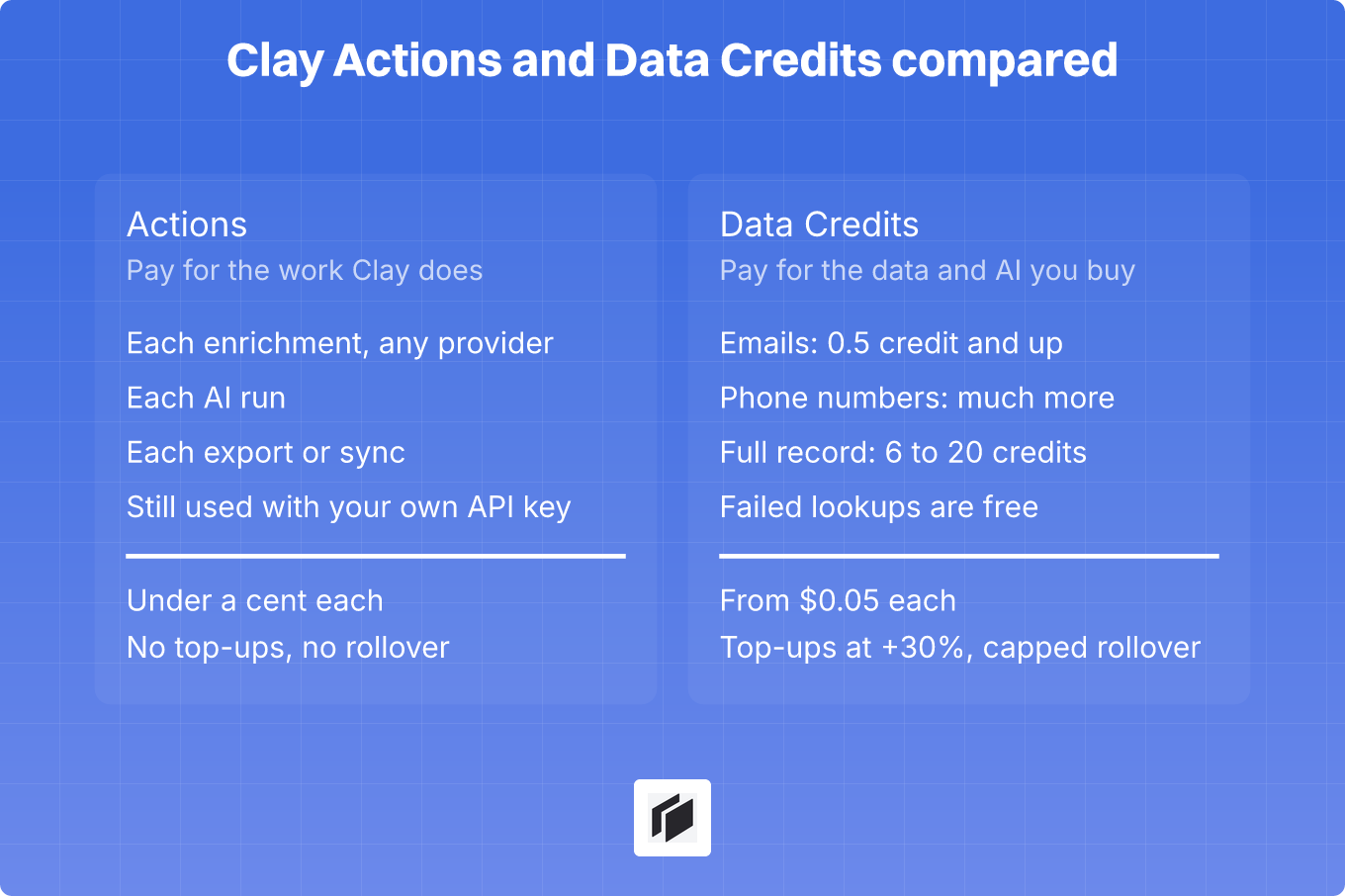
The two meters are billed side by side. One covers the work Clay does, the other covers the data it buys for you.
Actions pay for the work
An Action is used for each record Clay enriches or exports, whichever provider is behind it. That includes each enrichment (even with your own API key), each AI run, each export or sync to a CRM, sequencer, ad audience or warehouse, and each lead added to a Clay sequencer campaign.
Searching for people or companies costs no Action, though it can cost Data Credits. Imports, formulas, filters, moving rows between tables and CSV export cost neither.
Clay says Actions cost less than a cent each. From the slider prices, the entry rate looks like roughly $0.004 per Action ($60 for 15,000 on Launch), but that is our reading of the pricing page, not a figure Clay states.
Data Credits pay for the data
A Data Credit buys data or AI from a marketplace of 150+ providers. Clay says credits start at $0.05 each and get cheaper at higher volume. Costs vary by data type:
- Emails: 0.5 credit per email found, per Clay’s docs.
- Validation: free with select validator providers.
- Phone numbers: Clay calls them expensive and shows the exact cost next to each enrichment.
- A fully enriched record: typically 6 to 20 credits.
A lookup that returns nothing costs no credits and no Action. With your own API key the credit charge disappears and the provider bills you directly, but the Action stays because Clay still runs the step. Clay enrichment explains how the providers and waterfalls behind those credits work.
What Clay costs per 1,000 leads
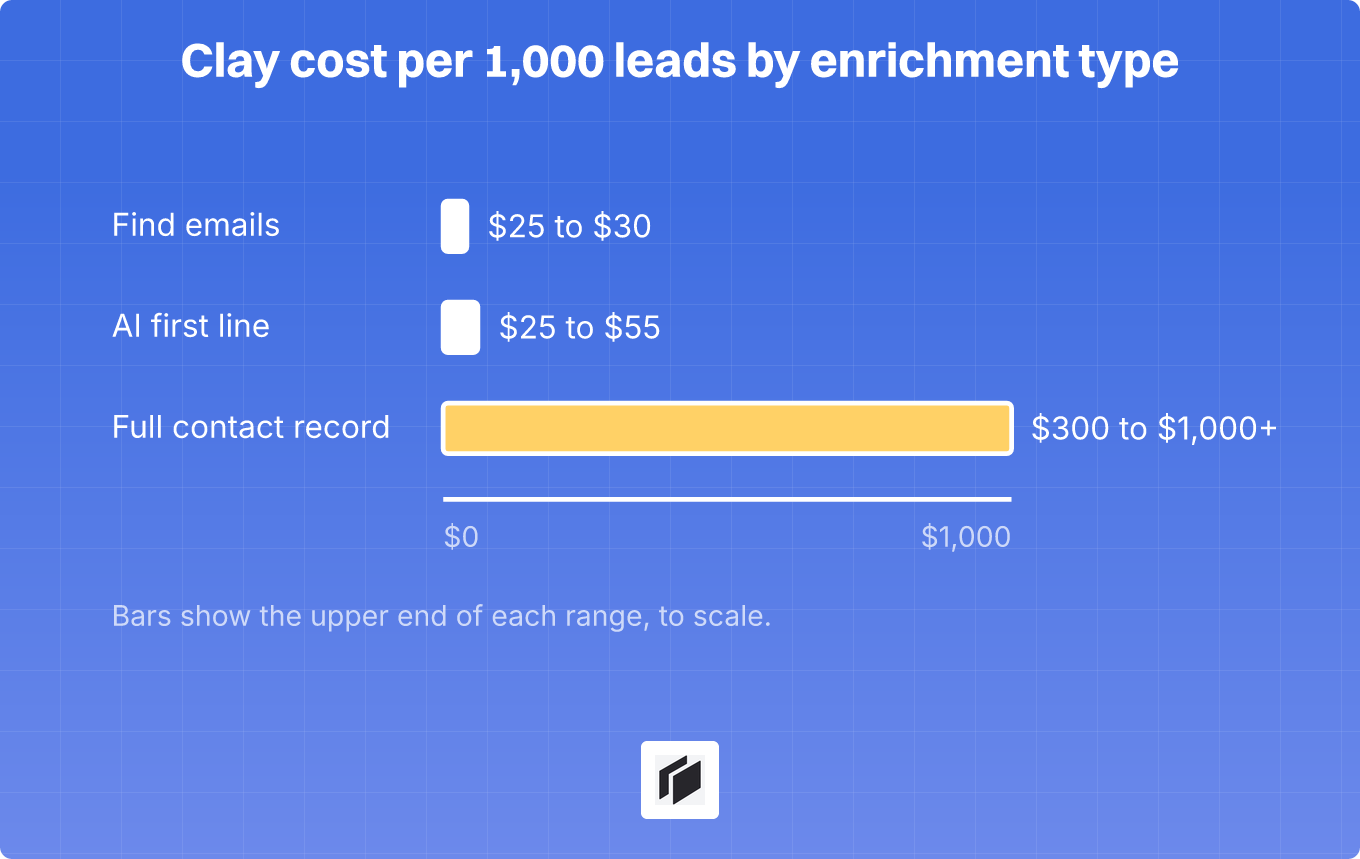
Credit prices are published, so the cost of a job is easy to estimate. The table uses $0.05 per credit and assumes every lookup succeeds. Actions add a few dollars per 1,000 records for each step, at the entry rate estimated above.
| Job on 1,000 leads | Data Credits | Approximate cost |
|---|---|---|
| Find emails | about 500 | $25 to $30 |
| Enrich LinkedIn profiles | about 500 | $25 to $30 |
| Validate emails (select validators) | 0 | a few dollars of Actions |
| Write an AI first line (0.4 to 1 credit, depending on the model) | 400 to 1,000 | $25 to $55 |
| Build a full contact record | 6,000 to 20,000 | $300 to $1,000 or more |
Email-only work is cheap in Clay, and the bill climbs when you ask for full records, phone numbers or heavy AI research on every row.
What a founder pays in a real month
Say you find and validate emails for 1,000 leads and write an AI first line for each. That uses about 1,200 Data Credits and 3,000 Actions, well inside what Launch includes. The usage itself is worth roughly $70.
The invoice is still $185, or $0.185 per lead. At low volume the plan fee sets your price per lead, not the credit rate. Unused Actions expire at the end of the month, and credits roll over only up to a cap.
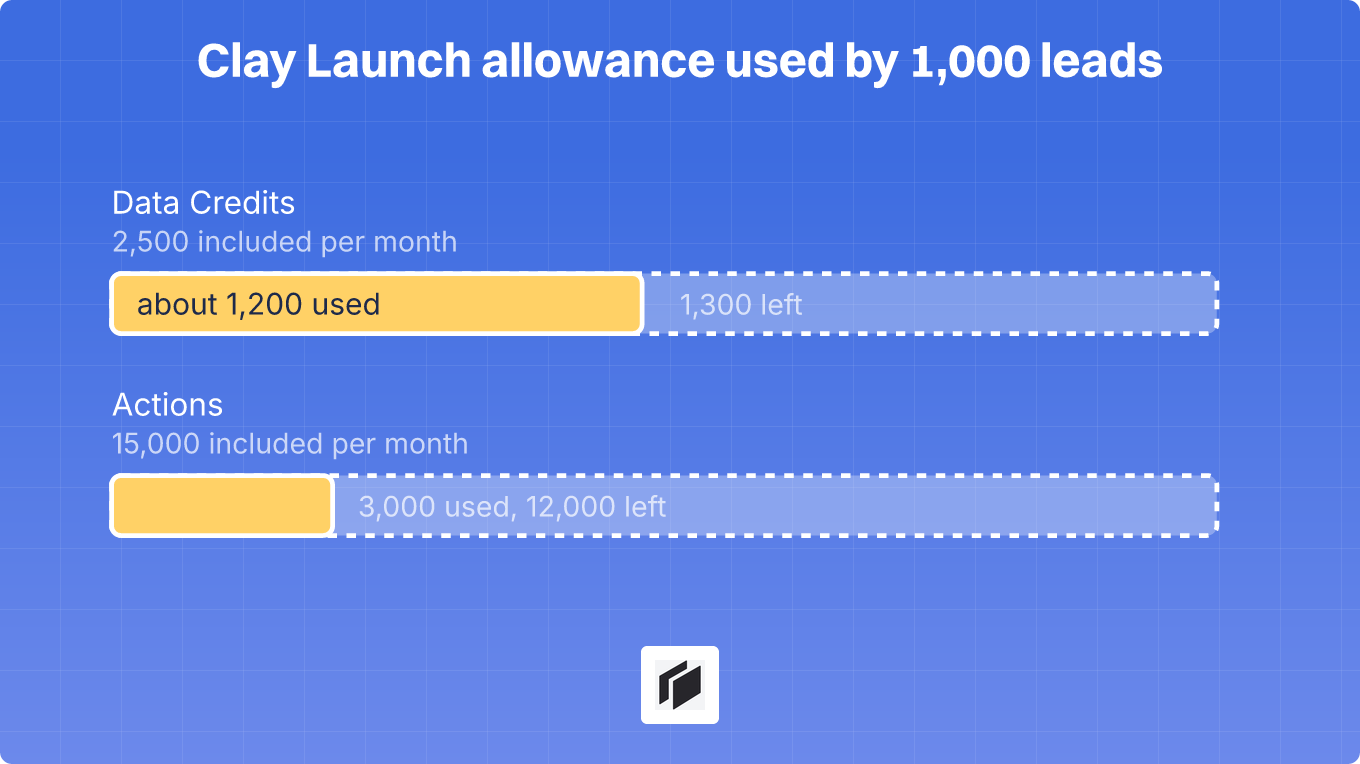
Full records break the plan in the other direction. 2,500 credits cover 125 to 416 of them, so a list of 1,000 pushes you into top-ups or a bigger tier.
Hidden costs and rules that move the bill
Several rules decide what you pay beyond the sticker price.
- Actions cannot be topped up. When they run out, you move to a higher Action tier. Credits can be topped up.
- Top-ups carry a 30% premium. That is about $0.065 a credit at the entry rate, and top-ups count against your rollover limit.
- Auto top-ups can charge your card. Admins can switch on automatic purchases when the balance falls below a threshold, capped at $1,000 each and $5,000 over any rolling seven days.
- Rollover is capped. On monthly plans your balance can reach twice your monthly credits. On annual plans up to 15% of annual credits carry over if you renew on the same plan or higher.
- Growth is gated by features. CRM sync, the HTTP API, webhooks and ad audiences all start on Growth, which costs $310 more a month than Launch ($279 on annual billing) whatever your volume.
- Credits burn without warning. Auto-run refreshes enrichments by itself, re-running a column enriches again, and a run you stop still pays for the requests already sent.
- Some AI is metered. Most models cost a flat number of credits. The most advanced ones bill the real model cost, and Clay shows an estimate first.
Test every new workflow on 10 to 20 rows, then read the Usage page in Settings before you run the full list.
Monthly or annual billing
Annual billing takes about 10% off Launch and Growth and gives you the credits up front.
| Plan | Monthly, 12 months | Annual | You save |
|---|---|---|---|
| Launch | $2,220 | $2,004 | $216 |
| Growth | $5,940 | $5,352 | $588 |
Pay monthly for the first two months, then switch. By then the Usage page shows how many credits and Actions you really burn.
The free plan is the other way to measure. It gives 100 credits a month and 200 rows per table, enough to learn the tool and not much more. Clay’s billing docs also describe a 14-day trial with 1,000 Data Credits.
Clay pricing vs alternatives
Clay has the most providers in this group and the highest entry price. Entry prices as listed on each vendor’s site, checked in November 2026:
| Tool | Entry price | What you get | Pricing model |
|---|---|---|---|
| Clay | $185/mo ($167 yearly) | 2,500 credits, 15,000 Actions, 150+ providers, Claygent, unlimited seats | Two meters |
| Apollo | $49 per user/mo (yearly) | Contact database with filters and a built-in sequencer | Per seat, plus credits |
| Airscale | $49/mo | 4,000 credits, waterfalls over 20 to 50+ providers, rollover | One credit meter |
| FullEnrich | $29/mo | Email and mobile finder checking 20+ vendors | Pay per result found |
| Persana AI | $68/mo (yearly) | AI prospecting playbooks, 100+ providers | Credits |
| Databar.ai | $99/mo | 5,000 credits, 80+ APIs, scraping | Credits |
| Cockpit | $29/mo | 3,000 credits, imports from LinkedIn, Google Maps, CSV and CRM, 27 enrichments with waterfalls, AI columns, sequences, export to Lemlist, Instantly, Smartlead or a CRM | One credit meter, you pay only for successful lookups, 14-day trial |
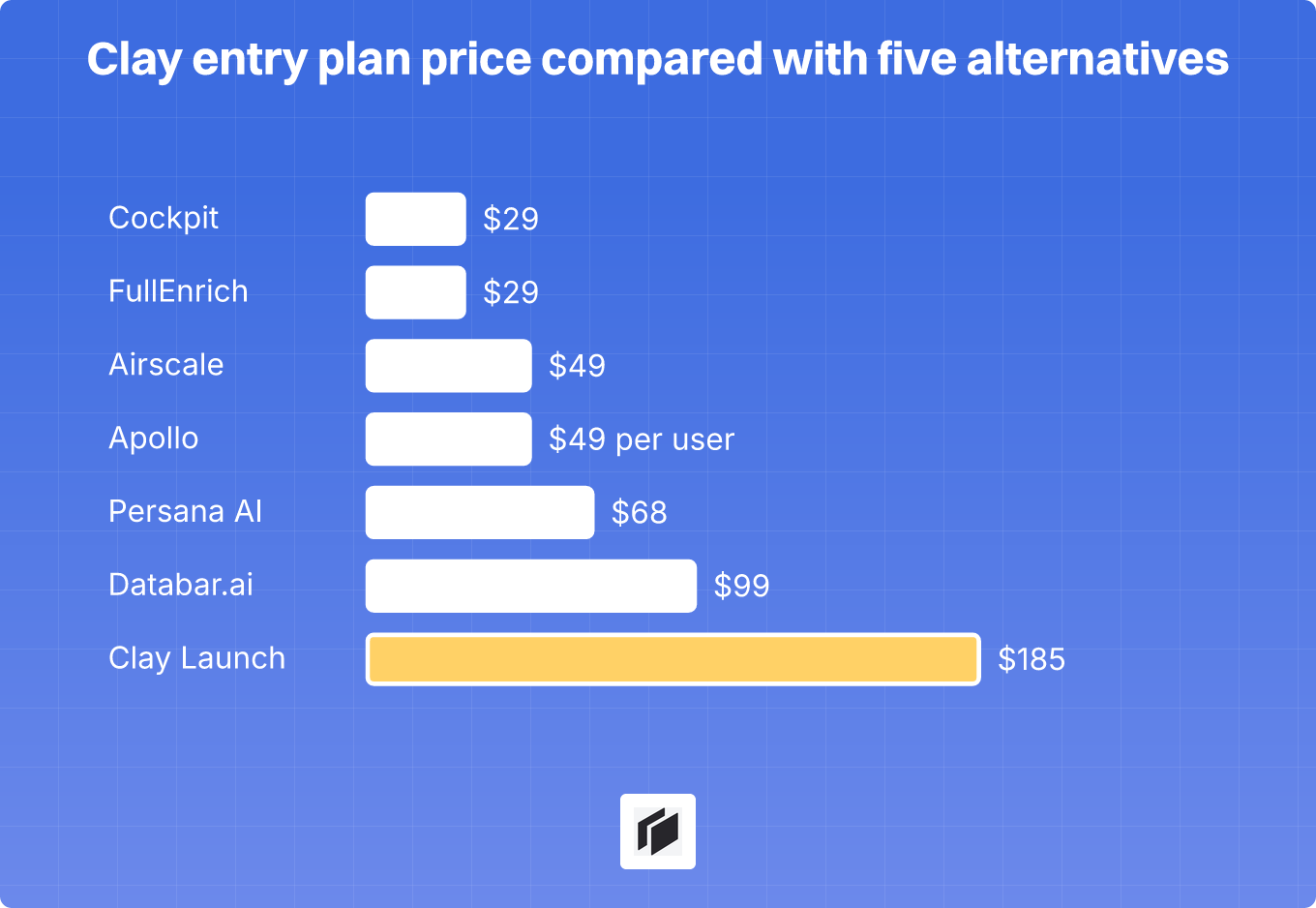
The tools solve different jobs. Apollo is a database, so the Clay vs Apollo comparison prices the same jobs on both. FullEnrich vs Clay and Airscale vs Clay do the same for the other two. Cheaper alternatives to Clay covers five more, and the Clay vs Cockpit comparison goes through ours line by line.
Cockpit connects fewer data sources than Clay’s 150+ providers, so it wins on entry price and simplicity, not on every line.
Is Clay worth the price?
For a small team doing straightforward outbound, usually not. Clay earns $185 a month when someone builds and maintains the workflow, and it fits two situations:
- A GTM engineer or an agency that turns 150+ providers, waterfalls and signals into data it cannot get elsewhere, and uses Growth’s CRM sync and ad audiences to send it somewhere.
- A team that keeps growing. Unlimited seats make Clay cheaper per head with every hire.
For a founder or a team of two to five who wants to upload a list, find emails, write a first line and send, the plan fee outweighs the data. In the month above you used about $70 of data and paid $185. A tool with a lower floor and one meter does the same job for less, and Clay stays an option for the day your workflow outgrows it.
If you want to try the simpler route, Cockpit puts import, enrichment, AI columns and sequencing in one spreadsheet. For the product side of Clay, read the Clay review .
FAQ
How much does Clay cost per month?
Free is $0. Launch is $185 a month, or $167 billed yearly, and Growth is $495, or $446 yearly. Enterprise is quoted.
Is Clay free?
Yes, with limits. The free plan includes 100 Data Credits and 500 Actions a month, tables of up to 200 rows, and no phone number enrichment.
How much is one Clay credit worth?
A Data Credit starts at $0.05 and gets cheaper as you buy more. An Action costs less than a cent.
Does Clay charge per seat?
No. Every plan has unlimited seats, so only Actions, Data Credits and plan tier move the bill.
What happens when you run out of Clay credits?
A run stops when the balance hits zero. You can raise the Data Credit slider, buy a top-up at a 30% premium, or move to a higher Action tier if Actions ran out first. With auto top-ups on, Clay buys credits for you.